We A/B tested 14 headlines on a startup landing page. The winner had 3 words.
Not "AI-Powered Revolutionary Platform For Modern Teams." Three words. Shorter headlines consistently outperform bloated ones — in our case, the gap was over 30%. Every extra word we'd added before was actively losing us signups.
This is the core problem with startup landing pages: founders treat them like pitch decks. They cram in every feature, every benefit, every possible objection handler, every testimonial they've ever received. The result is a 4,000-word monument to anxiety — a page that screams "I'm not sure what my product does, so I'll say everything and hope something sticks."
Your landing page is a bouncer at a club. Three seconds to decide who gets in. Not a dissertation committee.
90% of Startup Landing Pages Are Too Long
I'm going to say something that goes against every "landing page best practices" blog post you've read: most startup landing pages would convert BETTER if you cut them in half.
Here's why. The conventional wisdom says "longer pages convert better." And that's true — for established companies with known products and warm traffic from branded search. Somebody googling "Salesforce pricing" is ready to read 2,000 words because they already know what Salesforce does.
Your startup is not Salesforce. Nobody knows what you do. Nobody trusts you yet. Nobody is going to read 2,000 words to find out.
The data from early-stage startups tells a different story. Pages under 800 words routinely outperform pages over 2,000 words for cold traffic. Not because shorter is inherently better — but because shorter forces clarity. When you have 800 words, you can't hide behind vagueness. Every sentence has to earn its place.
When we analyze new startup ideas at Foundry, the founders who can explain their product in one sentence consistently score higher on market viability. If you can't say it clearly in one sentence, your landing page won't save you — no matter how many sections it has.
The 7 Sections (and Which Ones to Actually Use)
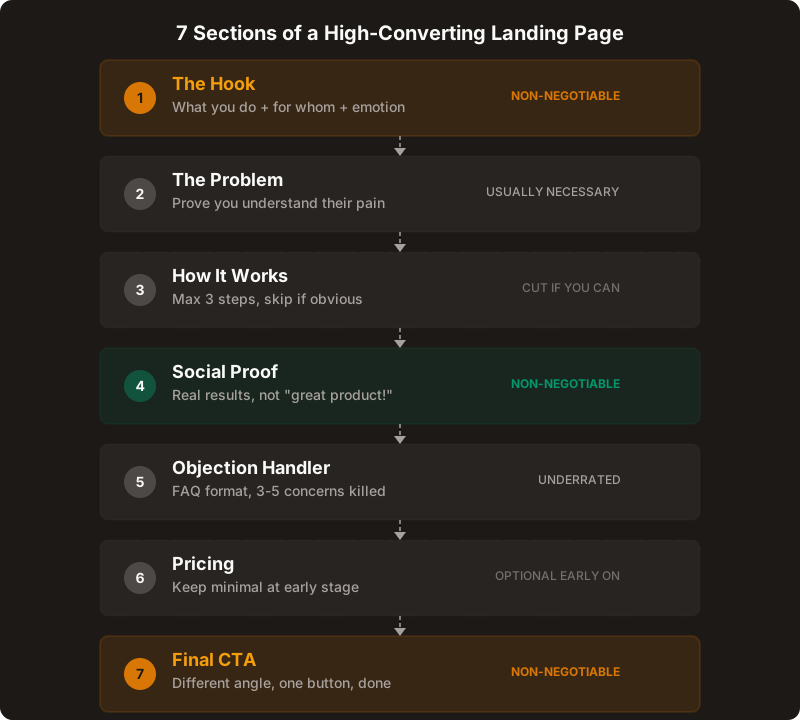
Here's the full anatomy. But here's the twist — you probably only need 4-5 of these. I'll tell you which to cut.
1. The Hook (Non-Negotiable)
Not "hero section." Not "above the fold." The Hook.
You have exactly one job here: make the visitor understand what you do AND feel something. Understanding without emotion = bounce. Emotion without understanding = confusion.
The formula that works for startups:
Headline: What you do + for whom + what changes. "Send invoices that get paid in 3 days, not 30." That's it. No "revolutionary" or "next-generation."
Subheadline: One sentence of proof or specificity. "Used by 400 freelancers who got tired of chasing payments." Notice: a real number, a real persona, a real pain.
CTA: One button. ONE. Not "Start Free Trial" and "Watch Demo" and "Read More." One action. Make it specific — "Send Your First Invoice" beats "Get Started" every time.
Kill the stock photo. Kill the abstract gradient illustration. Show your actual product. A screenshot. A 10-second GIF of it working. People want to see the thing before they commit to anything.
2. The Problem (Usually Necessary)
This is where you prove you understand their pain. Not "managing X is challenging in today's fast-paced world." No. Be specific. Be visceral.
Bad: "Teams struggle with communication." Good: "You sent that Slack message 3 hours ago. Nobody replied. So you sent an email. Then a follow-up. Now you're wondering if anyone's actually working."
Two to three sentences. That's it. If you nail the problem description, the visitor's internal monologue is "this person gets it." That's trust. And trust converts.
3. The "How It Works" (Cut It If You Can)
Hear me out. If your product is self-explanatory from the Hook screenshot — skip this section. Another section is another chance to lose the reader.
If your product IS confusing (anything involving workflows, integrations, or multiple steps), keep it. But max 3 steps. Not 5. Not 7. Three.
And don't make them cute. "1. Connect your stuff. 2. Magic happens. 3. Profit!" — that tells me nothing. "1. Paste your Stripe API key. 2. We analyze 90 days of data. 3. See exactly where you're losing revenue." — now I understand what I'm buying.
4. Social Proof (Non-Negotiable, But Done Wrong by Everyone)
"Trusted by 10,000+ companies." Cool. Which companies? What did they accomplish? A number without context is wallpaper.
What actually works:
- One specific testimonial with a name, photo, company, and a RESULT. "Cut our invoice time from 4 hours to 20 minutes" — Sarah Chen, Freelance Designer." Not "Great product! Highly recommend!" which could be written by anyone, including your mom.
- Logos if you have recognizable ones. If your biggest customer is your friend's startup nobody's heard of, skip the logos.
- A number that matters. "$4.2M in invoices sent through our platform." This is social proof AND value proposition in one. Much stronger than "500+ happy customers."
Don't have social proof yet? Don't fake it. Use a beta waitlist count, a specific user story (even if it's just one person), or skip this section entirely. Fake testimonials are worse than none — people can smell them.
Building a landing page for a product nobody wants is a waste of pixels. Validate your idea first — Foundry's AI takes 5 minutes.
Try Foundry — free5. Objection Handler (Underrated — Most Pages Skip It)
Every visitor has a reason not to sign up. Your job is to surface that objection and kill it before they leave.
Three objections that kill most startup signups: "Is this safe?" (one sentence about encryption + a padlock icon), "Is it hard to set up?" ("2-minute setup, no code"), and "What if I don't like it?" ("14-day free trial, no credit card"). That last one alone can boost conversion 10-20%. FAQ accordion format. 3-5 questions. Keep answers under 2 sentences each.
6. Pricing (Maybe — Depends on Your Model)
Hot take: if you're early stage, don't put pricing on your landing page. You don't know your pricing yet. You THINK you do. Once someone sees $19/month, they'll feel cheated at $29/month even if you added features. Anchoring effects are real.
If you must show pricing, read our piece on pricing without guessing first. For early-stage: "Start free. Paid plans from $X/month." One line. Separate pricing page. Keep the landing page focused on one action.
7. Final CTA (Non-Negotiable)
The bottom of the page. One more shot.
Don't repeat the same CTA from the Hook word-for-word. Change the angle. If the top CTA was feature-focused ("Send Your First Invoice"), make the bottom CTA outcome-focused ("Stop Chasing Payments").
One sentence of reinforcement. One button. Done.
Resist the urge to add a "P.S." paragraph, a newsletter signup, social media links, a blog preview, and a footer menu. Every additional element at the bottom competes with your CTA. The page should feel like a funnel that narrows to a single point: click the button.
The Only Metric That Matters (and It's Not What You Think)
Most founders obsess over conversion rate. "We're converting at 3.2%!" Okay, but 3.2% of WHAT? Of paid traffic? Organic search? Direct visits from people who already know you?
The metric that actually matters for early-stage landing pages: visitor-to-qualified-action rate from cold traffic. Not total signups. Signups from people who've never heard of you before and landed on your page from a cold source — a Reddit post, a cold DM, a Product Hunt listing.
Benchmarks for cold traffic to startup landing pages:
- Below 1%: Your page has a fundamental problem. Usually the Hook or the targeting.
- 1-3%: Normal for cold traffic. Optimize but don't panic.
- 3-5%: Good. Your messaging resonates. Start testing variations.
- Above 5%: Excellent. Your product-market fit is showing through the page. Scale traffic.
For warm traffic (people who know you from building in public, referrals, etc.), double these numbers. If you're getting 2% from warm traffic, something is deeply broken.
Your Landing Page Isn't a Brochure
It's a filter. Its job is to take someone who's vaguely interested and either convert them into a user or bounce them fast — so you're not wasting their time or yours.
Every section you add is a decision point where someone can leave. So every section needs to earn its survival. If you can't point to a specific objection or question that a section answers — cut it.
Here's my dare: take your current landing page. Delete the bottom half. Run it for a week. Measure. I bet you'll be surprised.
Ready to build a startup worth putting a landing page in front of? Foundry's AI validates your idea first — because the best landing page in the world can't save a product nobody wants.
Marcus Graham
Building tools that help founders validate ideas and launch faster.
AI can find your perfect startup niche in 5 minutes
Two AI agents debate your idea and give you an honest, data-backed assessment. Free.
Find My Niche