You're undercharging. I know this without seeing your product, your market, or your metrics.
How do I know? Because almost every founder undercharges. It's a universal disease — a cocktail of impostor syndrome, fear of rejection, and the desperate logic of "I'll charge less and make it up on volume." You won't. Volume is a fantasy at your stage.
Here's the uncomfortable truth: if the thought of doubling your price makes you nauseous, your price is too low. That nausea isn't data. It's fear. And fear is the worst pricing strategist on the planet.
The 15-Minute Pricing Problem
Most founders spend 6 months on code and 15 minutes on pricing.
The 15 minutes usually go like this: check competitors, find the cheapest one, price 20% below them. Done. Back to building features.
This is insane. Pricing affects EVERYTHING — your conversion rate, your customer quality, your churn, your support load, your positioning, your ability to run ads profitably. A 10% improvement in pricing hits your bottom line harder than a 10% improvement in acquisition. But nobody writes blog posts about pricing. It's not sexy.
When we run startup evaluations through Foundry's debate engine, pricing is the #1 thing the Destroyer AI attacks. "Your $15/month plan targets SMBs who churn at 8% monthly — your LTV is $187, but your CAC will be $150+. The math doesn't work." We see this pattern in 7 out of 10 evaluations. Founders nail the product. They butcher the price.
The 10x Value Rule (and Why It's Only the Starting Point)
The classic framework: charge 1/10th of the value you create. If your tool saves someone $1,000/month, charge $100/month. Simple.
But there's a problem. How do you MEASURE value?
For some products it's obvious. "Our tool replaces a $5,000/month contractor" — easy. Charge $500/month. But what about "our tool makes meetings more productive"? What's 15% more productive meetings worth? Good luck putting a number on that.
The 10x rule works when value is quantifiable and directly tied to money. For everything else, you need other frameworks.
Also — the 10x rule assumes rational buyers. Real humans don't calculate ROI in spreadsheets before purchasing a $29/month tool. They check if it feels worth it. "Feels" is doing a LOT of heavy lifting in that sentence.
Three Frameworks That Actually Replace Guessing
Van Westendorp's Price Sensitivity Meter
This sounds academic. It isn't. It's four questions you ask 20-30 potential customers:
- At what price would this be so cheap you'd question its quality?
- At what price is this a bargain — a great deal?
- At what price is this getting expensive but you'd still consider it?
- At what price is this too expensive — you'd never buy it?
Plot the answers. The intersection points give you a price range. The "sweet spot" is between the "bargain" and "getting expensive" lines.
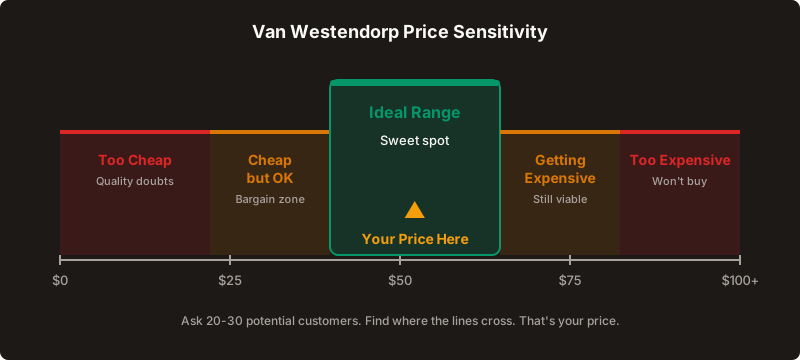
I ran this for a SaaS in 2024. My gut said $19/month. The data said $39-49/month. I launched at $39. Nobody blinked. The "too expensive" threshold? $89/month. I'd left $50/month on the table because of vibes.
The catch: you need honest respondents who actually represent your buyers. Don't ask your friends. Don't ask other founders. Ask people who feel the pain your product solves.
Anchoring (The Restaurant Menu Trick)
Ever notice how nice restaurants put a $95 steak at the top of the menu? Nobody orders it. That's not the point. The point is that the $42 salmon suddenly looks reasonable by comparison.
Your pricing page works the same way. Three tiers:
- Decoy tier: Expensive, loaded with features most people don't need. Maybe 5% of customers pick it. Its job is to make the middle tier look smart.
- Target tier: This is what you actually want people to buy. Price it at 60-70% of the decoy. Highlight it. Put a "Most Popular" badge on it.
- Entry tier: Cheap enough to convert price-sensitive buyers, but limited enough that they'll upgrade within 2-3 months.
Basecamp broke this mold — one price, $349/month flat, everyone gets everything. And they're printing money. But Basecamp is Basecamp. They have 20 years of brand equity. You don't. Use anchoring until you do.
The "Raise Until They Flinch" Method
This one's crude. It works.
Start higher than feels comfortable. When a prospect says your price out loud, watch their face. If they don't flinch — raise it. Keep raising until roughly 20% of prospects say "that's too expensive."
If NOBODY objects to your price, it's way too low. You want a healthy objection rate of 15-25%. That means you're capturing maximum value while still converting enough.
Patrick Campbell at ProfitWell (acquired by Paddle for $200M) preached this constantly: "The best SaaS companies lose 20% of deals on price. The worst lose 0% — because they're practically giving it away."
Ready to stress-test your pricing strategy? Foundry's AI Destroyer finds every hole in your unit economics before your bank account does.
Try Foundry — freeThe Fear Tax: What Undercharging Really Costs
Let's talk numbers. Say you're at $19/month with 200 customers. That's $3,800 MRR.
Now imagine you'd charged $39/month instead. "But I'd get fewer customers!" — maybe. Let's say you lose 30% of them (generous — most studies show price elasticity in SaaS is much lower than founders think). That's 140 customers at $39 = $5,460 MRR.
$5,460 vs $3,800. Same product. Fewer support tickets. Better customers (people who pay more churn less — this is one of the most consistent patterns in SaaS). And you have more revenue to reinvest in growth.
But wait. Those 140 customers at $39? They actually RESPECT the product more. They use it more deliberately. They refer other serious users. The ones you "lost" at $19? They were the ones who'd churn in month 3 anyway — tire-kickers looking for the cheapest option.
Undercharging doesn't just cost revenue. It attracts the wrong customers, drains support resources, and positions your product as "cheap" — which is a brand problem that's murder to fix later.
What 500+ Evaluations Taught Us About Pricing
When Foundry's Destroyer AI stress-tests a startup idea, pricing failures cluster into three buckets:
1. Pricing for competitors instead of value. "Competitor charges $29 so I'll charge $19." You just told the market you're 35% worse. If you can't articulate why you're DIFFERENT, competing on price is a race to zero.
2. One-size-fits-all. A freelancer making $4K/month and an agency making $80K/month experience DIFFERENT value from the same tool. Charge them differently. Per-seat pricing, usage tiers, feature gates — pick a mechanism that scales with value delivered.
3. Pricing too low to fund growth. At $9/month, you need 1,111 customers to hit $10K MRR. At $49/month, you need 204. Which is more achievable when you're one person with no marketing budget? When you're figuring out how to get those first customers with zero budget, every dollar of MRR matters.
(Yes, I know someone will email me about their $9/month product with 50K users. Congratulations. You're the exception. The rest of us need to charge more.)
The Pricing Conversation You Should Have Today
Stop reading pricing articles. Do this instead:
Email five customers. Ask: "If we doubled our price tomorrow, would you stay?" If all five say yes without hesitation — you know what to do. If three say yes and two hesitate — you're in the zone. If all five say no — you either have a pricing problem or a value problem, and those require very different fixes.
Then ask: "What would make this worth twice what you're paying?" Their answers are your product roadmap AND your pricing strategy in one.
Want to stress-test your pricing before you launch? Foundry's AI debate pits your business model against a Destroyer that finds every hole in your unit economics. Better to hear "your pricing is broken" from an AI than from your bank account.
Marcus Graham
Building tools that help founders validate ideas and launch faster.
AI can find your perfect startup niche in 5 minutes
Two AI agents debate your idea and give you an honest, data-backed assessment. Free.
Find My Niche