Last month a founder DM'd me: "I've been posting on LinkedIn for 3 months. Zero signups. What am I doing wrong?"
I asked one question: "Have you personally reached out to anyone who has the problem you solve?"
Silence.
This is the disease. We've been brainwashed into thinking "marketing" means broadcasting into the void and waiting for strangers to come to us. That's not marketing. That's praying.
Your first 100 customers will come from dark, sweaty, unscalable places. Cold DMs. Forum comments. Literally begging people to try your thing. And if that sounds beneath you — you're not ready to be a founder.
Paid Ads at Seed Stage Are a Bonfire
I need to get this out of the way because someone's about to drop $2K on Facebook ads.
Don't.
Here's what happens: you write ad copy based on assumptions (you haven't talked to enough customers to know what resonates). You target an audience based on guesses. Facebook's algorithm needs 50+ conversions to optimize — at a $50 CAC, that's $2,500 just for the algorithm to START learning. And your landing page probably converts at 1-2% because you haven't iterated on it yet.
You're burning cash to train an algorithm that needs data you don't have, to send traffic to a page that doesn't convert, with messaging you haven't validated. That's not marketing. That's expensive therapy.
Paid ads work when you know three things: your customer, your message, and your conversion rate. At launch, you know zero of those. Earn that knowledge with free channels first. Then pour gasoline on what's already burning.
The Ugly Ladder: 5 Tactics Ranked by Effort vs. Impact
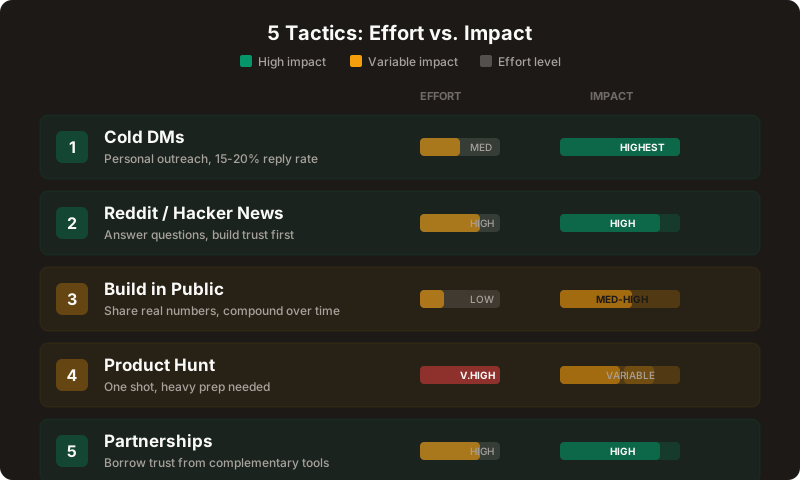
I'm ordering these from "highest impact per hour invested" to "slowest burn but compounding." This isn't a buffet — start at #1 and work down.
1. Cold DMs That Don't Suck (Impact: Highest / Effort: Medium)
Stripe's origin story is famous for a reason. Patrick and John Collison literally walked up to people at events and said "can I install Stripe on your laptop right now?" Not "would you be interested in..." — they installed the damn thing on the spot. The Collison Installation, people call it.
You're not Stripe. But the principle is the same: find someone with the problem, offer to solve it for them right now.
The formula for a cold DM that gets replies:
- Show you did homework. "I saw your tweet about struggling with X." Not "Hey, I'm building a thing."
- Be specific about the value. "I built something that does Y in 5 minutes instead of 3 hours."
- Make it free / effortless. "Can I set it up for you? No strings."
- Keep it under 4 sentences. Respect their time.
I've seen founders get 15-20% reply rates on Twitter DMs with this approach. LinkedIn is worse — maybe 5-8% — but the leads are higher quality for B2B. Reddit DMs? Don't. You'll get banned.
The secret nobody tells you: the first 10 customers should feel like favors, not transactions.
2. Reddit and Hacker News — But Not How You Think (Impact: High / Effort: High)
If your instinct is to post "Hey everyone, I built X! Check it out!" — stop. That's spam, and both communities will eat you alive.
What works: answer questions that your product solves. Every day, people post on r/startups, r/SaaS, r/Entrepreneur asking questions. "How do I validate my idea?" "What tool should I use for X?" Find those questions. Give genuinely helpful answers. Mention your product ONLY if it's directly relevant, and only after you've provided real value.
On Hacker News, "Show HN" posts work if your product is technically interesting. But the real gold is commenting thoughtfully on relevant threads for weeks before you ever mention your own thing. HN has a karma system and a BS detector that makes Reddit look gentle.
One founder I know got 400 signups from a single HN comment. Not a post — a comment. He'd been a helpful community member for months. When he mentioned his product, people trusted him. That trust was worth more than any ad spend.
Don't know who your first customers are? Foundry's AI figures out your ideal buyer persona, where they hang out, and what makes them pay. 5 minutes.
Try Foundry — free3. Building in Public (Impact: Medium-High / Effort: Low-Medium)
Building in public is the closest thing to free marketing that actually compounds. But most people do it wrong — they post vanity metrics and screenshots of dashboards.
What actually works: share the ugly parts. Revenue numbers (including when they're embarrassingly small). Mistakes you made. Features that nobody used. The customer who churned and why.
People follow authentic struggle. Nobody follows "Just hit $10K MRR! Here's my 7-step framework!" — that's LinkedIn performance art.
The playbook:
- Weekly updates on Twitter/X with real numbers. "Week 12: $340 MRR, 3 churns, redesigned onboarding because 60% dropped at step 2."
- One long-form post per month — a genuine lesson learned. Not "5 tips for SaaS growth." More like "I spent 2 weeks on a feature nobody asked for. Here's how I'm recovering."
- Reply to EVERYONE who engages. Every single person. This doesn't scale. That's the point.
When we analyze startup journeys on Foundry, the founders who document their process in public consistently get better validation signals than those who build in stealth. The public accountability forces honesty.
4. Product Hunt — One Shot, Make It Count (Impact: Variable / Effort: Very High)
Product Hunt is a slot machine. Some launches get 2,000 upvotes and 500 signups. Others get 47 upvotes and a tumbleweed.
The difference isn't the product. It's the preparation.
What actually moves the needle:
- Build an audience BEFORE launch. If you don't have 200+ people who'll upvote on day one, you're gambling. This means 4-6 weeks of pre-launch relationship building.
- Launch Tuesday-Thursday. Monday is crowded with weekend builders. Friday everyone's checked out.
- Get a known hunter. Products launched by established hunters get 3-5x more visibility.
- Your tagline is everything. You get maybe 8 words on the homepage feed. "AI-powered project management" makes eyeballs glaze over. "Stop losing clients to missed deadlines" gets clicks.
Dirty secret: 80% of Product Hunt signups are other makers who'll never become paying customers. Your REAL acquisition from PH is maybe 10-20% of total signups. Worth it for early feedback. Not for sustainable growth.
5. Partner With Someone Who Already Has Your Audience (Impact: High / Effort: Variable)
This is the most underrated tactic on the list.
Find a complementary tool — not a competitor, but a product whose users would also need yours. If you built an invoicing tool, partner with a freelancer time-tracking app. If you built a landing page builder, partner with an email marketing tool.
The partnership can be simple: a co-written blog post, a webinar, a mutual email to each other's lists, an integration that benefits both products. You're borrowing trust from someone who already earned it.
One cold email to the right partner can be worth more than 1,000 cold DMs to individual users. But you need something to offer — make it about THEIR audience's benefit, not yours.
The Pattern Foundry Sees Over and Over
We've analyzed hundreds of startup evaluations through our AI debate engine. Here's what the data shows: founders who plan for viral loops and paid acquisition before they have 10 happy customers almost always stall.
The ones who grow? They do things that look stupid at scale. Handwritten onboarding emails. Personal Loom videos for each new signup. Slack channels with 15 members where they're the most active participant.
These things don't scale. That's the whole point. You're not trying to reach millions. You're trying to find 100 people who genuinely care.
After you have those 100? THEN you know your message. THEN you know your conversion rate. THEN you pour money into ads.
(I can already hear it: "but my product is different, it's viral by nature." No. It isn't. Not yet. Go DM 50 people.)
Your Move
You don't need a budget. You need nerve. The willingness to put your thing in front of real humans, handle the rejection, and iterate on what you hear back.
Start with 10 cold DMs today. Not tomorrow. Today. Find 10 people who have the exact problem you solve and reach out. Five won't reply. Three will say "not interested." One will say "tell me more." That one person is worth more than any marketing budget.
Not sure who to target? Foundry's AI figures out your ideal first customer in 5 minutes — who they are, where they hang out, and what makes them buy.
Marcus Graham
Building tools that help founders validate ideas and launch faster.
AI can find your perfect startup niche in 5 minutes
Two AI agents debate your idea and give you an honest, data-backed assessment. Free.
Find My Niche