$54 Per Month
That's what it costs to run a SaaS in 2026. Not $540. Not $5,400. Fifty-four dollars, and you get hosting, database, authentication, payments, email, analytics, and error tracking.
I'm going to walk through every tool, every tier, every dollar. No affiliate links. Just what actually works when you're one person building a product and every $10/month matters.
Because here's the dirty secret of the solopreneur world: half the people tweeting about their "tech stack" are spending more time configuring tools than building their product. Tool shopping is procrastination disguised as infrastructure work. And it's killing your launch date.
You need seven tools. Not fifteen. Seven.
The Stack
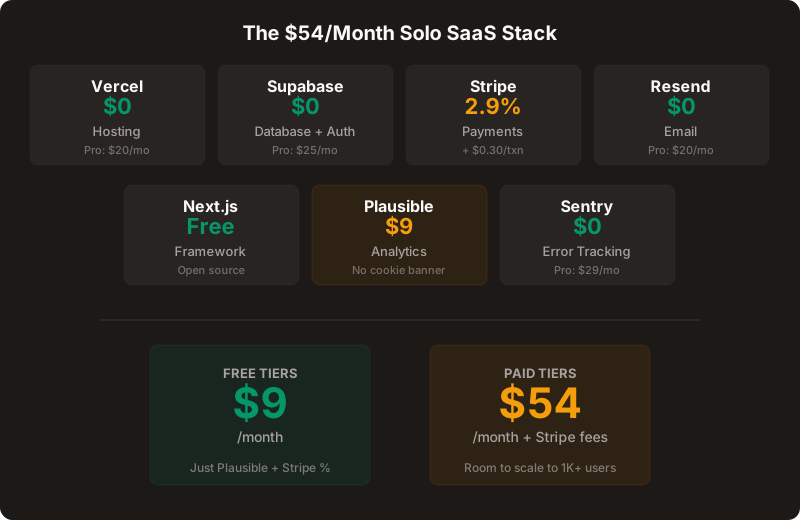
1. Hosting: Vercel — $0/month (Hobby) or $20/month (Pro)
Start on the free tier. Seriously. Vercel's Hobby plan handles way more traffic than you think — we're talking thousands of visitors before you even need to think about upgrading. Deploy by pushing to Git. SSL included. Edge functions if you need them.
Alternative: Railway ($5/month) if you need a traditional server. Fly.io ($0-5/month) for Docker containers. Netlify is fine too but Vercel's DX is better.
When to upgrade: When you hit 100 paying customers or need server-side features that edge functions can't handle. Until then, free is free.
2. Database: Supabase — $0/month (Free) or $25/month (Pro)
Postgres. Auth. Storage. Real-time subscriptions. Row-level security. All in one dashboard. The free tier gives you 500MB of database storage and 1GB file storage. That's enough for your first 1,000+ users.
Supabase is the single best thing that happened to solo developers in the last three years.
Alternative: PlanetScale ($0-39/month, MySQL), Neon ($0-19/month, Postgres), or just a $5 Digital Ocean droplet with Postgres if you enjoy pain.
When to upgrade: When your database hits 400MB or you need more than 50,000 monthly active users on auth. Both of which are champagne problems.
3. Auth: Supabase Auth — $0/month (included)
If you're using Supabase for the database, auth is already there. Email/password, magic links, OAuth with Google/GitHub/Twitter. Don't bolt on a separate auth service. Don't build your own. Please, for the love of shipping, don't build your own auth.
Alternative: Clerk ($0-25/month) if you want a prettier UI. Auth.js (free, self-hosted) if you want control. Lucia (free, lightweight) if you're a minimalist.
When to think about changing: When you need enterprise SSO (SAML, SCIM). That's not month one. That's month thirty.
4. Payments: Stripe — 2.9% + $0.30 per transaction
There is no alternative. I mean, technically there are alternatives. But unless you have a specific reason (crypto payments, selling in markets Stripe doesn't support), just use Stripe.
The API is beautiful. The docs are the best in tech. The dashboard tells you everything. And every third-party tool integrates with it.
Cost at $5K MRR: roughly $175/month in fees. That's your payment processing, invoicing, subscription management, tax calculation, and fraud prevention. Try getting all that for $175 anywhere else.
Alternative: Lemon Squeezy ($0 + 5% per transaction) handles sales tax globally, which is huge if you don't want to deal with VAT. Higher percentage, but simplicity has value.
5. Transactional Email: Resend — $0/month (up to 3,000 emails)
Password resets, welcome emails, invoice receipts. You need these from day one. Resend is built by the team that made React Email, so the DX is excellent. Free tier covers 3,000 emails/month — that's more than enough for a solo SaaS with under 500 users.
Alternative: Postmark ($15/month, 10K emails — arguably the best deliverability in the business). Amazon SES ($0.10 per 1,000 — cheapest but raw). Don't use SendGrid; every solopreneur I know has a horror story.
When to upgrade: When you start sending marketing emails too. Then consider Loops ($49/month) or Buttondown ($9/month for newsletters).
6. Analytics: Plausible — $9/month
Not Google Analytics. GA4 is a nightmare that nobody understands, not even the people at Google. Plausible gives you what you actually need: visitors, sources, top pages, conversions. One dashboard. No cookie banner required (it's privacy-friendly). Nine bucks.
Alternative: Umami (free, self-hosted) if you want to save $9. PostHog ($0 free tier) if you want product analytics too (funnels, session recordings). Fathom ($15/month) if you have Plausible-envy but want a different UI.
7. Error Tracking: Sentry — $0/month (Developer tier)
Your users will find bugs you never imagined. Sentry catches errors in production and gives you the stack trace, the browser, the user action that triggered it. Free tier covers 5,000 events/month.
Skip this and you'll spend hours trying to reproduce bugs from vague user reports like "it doesn't work." I learned this one the expensive way.
Alternative: Highlight.io ($0 free tier, includes session replay). LogRocket ($0 free tier). Or just window.onerror and a prayer.
The Total
| Tool | Free Tier | Paid Tier | |------|-----------|-----------| | Vercel | $0 | $20 | | Supabase | $0 | $25 | | Stripe | 2.9% + 30c | 2.9% + 30c | | Resend | $0 | $20 | | Plausible | — | $9 | | Sentry | $0 | $29 | | Total | $9 | $54 (+ Stripe fees) |
On free tiers: $9/month. On paid tiers with room to grow: $54/month plus Stripe's percentage.
That's it. That's the stack.
Got your stack picked out but no idea validated? Tools don't matter if nobody wants what you're building. AI stress-tests your idea in 5 minutes.
Try Foundry — freeWhat I Deliberately Left Out
CI/CD. GitHub Actions is free for public repos, 2,000 minutes/month for private. You don't need CircleCI or Jenkins. Push to main, Vercel deploys. Done.
Monitoring/uptime. BetterStack has a free tier. Or just use Vercel's built-in analytics. You don't need a $99/month observability platform when you have 47 users.
CMS. Unless you're building a content-heavy product, you don't need one. Write blog posts in Markdown. Store them in your repo. This blog you're reading right now? Markdown files in a Git repo.
Feature flags. You have 12 users. You can DM each one on Twitter. You don't need LaunchDarkly.
Customer support. A shared inbox. That's it. Gmail with labels. Upgrade to Crisp ($0 free tier) when you want a chat widget. You do NOT need Intercom at $74/month when you're pre-revenue.
This is where most solopreneurs go wrong. They build infrastructure for a company that doesn't exist yet. You're not Netflix. You don't need Datadog. Ship the product.
The "But What About Scale?" Trap
You know what scales? Revenue.
Every tool on this list handles 10x your current load without changes. Vercel handles millions of requests. Supabase Postgres handles hundreds of thousands of rows. Stripe handles... well, Stripe handles the internet's commerce.
When you hit $10K MRR and actually need to scale, you'll have $10K/month to solve scaling problems. That's a good problem. Today your problem is: does anyone want this thing?
I see this constantly when founders build their first product over a weekend with AI — they ship fast, then immediately want to "professionalize" the infrastructure. Resist that urge. Duct tape is fine. Duct tape that makes money is better than pristine architecture that doesn't.
At Foundry, we run our debate engine — two AI agents arguing about your startup idea in real-time — on a stack that isn't dramatically different from what I just described. We added a few things for AI inference, but the core? Postgres, Vercel, Stripe. Works fine. Ships fast.
Tools That Are Actually Worth Adding Later
Once you have paying customers — not before — consider:
PostHog (free tier) for product analytics. Where do users click? Where do they drop off? This only matters when you have enough users to see patterns.
Crisp ($0 free tier) or Intercom ($74/month) for live chat. But only when support volume exceeds what email can handle. For most solo SaaS, that's around 50+ paying customers.
An AI tool for founders that handles the stuff you shouldn't be doing manually — competitor monitoring, SEO optimization, code reviews. These are force multipliers, not infrastructure.
The Real Stack Is You
Here's the uncomfortable truth nobody puts in their "ultimate tech stack" posts:
The bottleneck isn't your infrastructure. It's you. Your ability to ship, to market, to listen to users, to fix bugs at midnight, to keep going when nobody cares yet.
Seven tools. $54/month. The rest is execution.
Test your startup idea before building the stack — Foundry's AI does it in 5 minutes →
Marcus Graham
Building tools that help founders validate ideas and launch faster.
AI can find your perfect startup niche in 5 minutes
Two AI agents debate your idea and give you an honest, data-backed assessment. Free.
Find My Niche