$847/Month on AI Tools
I'm going to tell you something embarrassing.
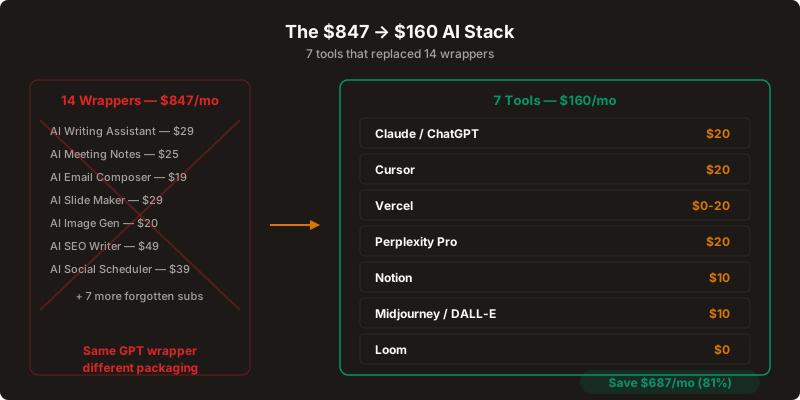
Last year, I was paying for 14 different AI tools. Fourteen. I had an AI writing assistant, an AI meeting summarizer, an AI email composer, an AI slide maker, an AI image generator, an AI code assistant, and about seven more I'd forgotten I was even subscribed to.
Total monthly bill: $847.
I now spend $160. The other $687 was buying the same GPT wrapper in different packaging.
The Wrapper Epidemic
Here's the dirty secret of the AI tools market: about half of what's out there is a thin UI layer on top of OpenAI's API. You're paying $29/month for something you could do with a $20 ChatGPT Plus subscription and a decent prompt.
How to spot a wrapper:
- The output looks exactly like ChatGPT. Copy-paste a result into ChatGPT and ask it to produce the same thing. If it's identical — wrapper.
- No proprietary data. If the tool doesn't have its own dataset, training, or fine-tuning, it's routing your input to GPT and formatting the output. That formatting costs you $25/month.
- "Powered by AI" but no technical detail. Real AI companies talk about their models, training data, and architecture. Wrappers say "powered by cutting-edge AI" and hope you don't ask follow-ups.
This isn't gatekeeping. Some wrappers are genuinely useful — if the UI and workflow save you enough time, the markup is worth it. But you should know what you're paying for.
The Stack That Actually Works
Seven tools. Not fifty. These are the ones I'd keep if I could only pick seven. Prices as of early 2026 — they change, so check.
1. Claude / ChatGPT ($20/month each)
Yeah, the boring answer. But here's the thing — 80% of what those 14 tools were doing, Claude or ChatGPT does natively. Email drafts, blog outlines, competitor research, code debugging, data analysis, brainstorming. One subscription replaces five wrappers.
I use Claude for longer reasoning and writing. ChatGPT for quick stuff and image gen. You don't need both — pick whichever clicks with your brain. But you need one.
Honest take: The gap between free and paid tiers is massive. The $20 is non-negotiable if you're building a company.
2. Cursor ($20/month)
Code editor with AI built in. Not "AI assistant you paste code into" — actual inline editing, multi-file awareness, and codebase understanding. If you write any code at all, Cursor pays for itself in the first week.
I watched a non-technical founder build a working MVP over a weekend using Cursor and Claude. Two years ago that would've required hiring a developer.
Honest take: Buggy sometimes. The AI suggestions can be confidently wrong. But it's still 5x faster than coding without it.
3. Vercel / Netlify (Free - $20/month)
Not AI tools per se, but the deployment layer that makes AI-built projects actually work. Push code, get a live URL. Free tier handles most early-stage needs.
Honest take: Vercel's free tier is generous. You'll only hit paid when you have real traffic — which is a good problem to have.
4. Perplexity Pro ($20/month)
Google Search that actually answers your question. For market research, competitor analysis, and "is there already a tool that does X?" queries, Perplexity saves hours of tab-juggling.
I use it before building anything. "What are the top 10 competitors in [niche]?" with sources. Try doing that on Google — you'll get SEO spam and listicles. Perplexity gives you the actual answer.
Honest take: Not perfect for obscure niches. Sometimes hallucinates sources. Always click through to verify anything you'll put in a pitch deck.
5. Eleven Labs ($5-22/month)
If your product needs voice — demos, explainers, podcast episodes — Eleven Labs is absurdly good. The voice cloning is borderline unsettling in quality. We used it for product demo voiceovers and saved roughly $2K vs. hiring voice talent.
Honest take: The cheap tier ($5) is very limited. You'll likely need the $22 tier for real usage. Still cheaper than one Fiverr voiceover.
6. Midjourney / DALL-E ($10-30/month)
Product mockups, social media visuals, pitch deck illustrations, blog images. One of these. Not both.
Midjourney for aesthetic, stylized stuff. DALL-E (via ChatGPT Plus) for quick and "good enough" visuals. I lean DALL-E because I already pay for ChatGPT.
Honest take: AI images still look subtly AI. For your landing page, consider paying a human designer for hero images. Use AI for everything else.
7. Notion AI ($10/month add-on)
Only if you already use Notion. The AI features inside your existing workspace — summarize meeting notes, draft project briefs, Q&A across your docs — are genuinely useful. Not worth switching to Notion just for the AI, though.
Honest take: 60% of what Notion AI does, you can do by pasting into Claude. The 40% difference is convenience — AI operating on YOUR data, in context.
Stop collecting tools. Start building. Foundry's AI evaluates your startup idea and tells you exactly what to build first — 5 minutes, free.
Try Foundry — freeWhat We Use at Foundry
Full transparency: Foundry runs on AI in ways most companies don't publicly talk about.
Our adversarial debate engine — the Seeker and Destroyer that evaluate startup ideas — is custom-built on top of Claude's API. Not a wrapper. Custom prompting architecture, persistent context across debate rounds, and scoring algorithms we've refined across thousands of evaluations.
For content and marketing, we use Claude directly. This blog, our SEO pages, our email copy — Claude with heavy human editing. The first draft is maybe 40% of the final product. The other 60% is a human cutting the AI-slop, adding real examples, and injecting opinions that a language model wouldn't have.
For code, Cursor. For deployment, Vercel. For research, Perplexity.
Total AI spend for the entire company: roughly $300/month. A fraction of what one additional employee would cost.
What to Skip
Saving you some money:
AI meeting summarizers (Otter, Fireflies, etc.) — Unless you're in 10+ meetings daily, just... take notes. Or ask ChatGPT to summarize the transcript after. $30/month to avoid writing three bullet points is not a founder decision.
AI social media managers — They schedule posts and "optimize" captions. The optimization is marginal. Buffer or a spreadsheet does 90% of the job. The AI part adds almost zero value.
AI "startup idea generators" — Random idea generators that spit out "Uber for dog walking" variations. No market analysis, no validation, no competitive research. Foundry exists specifically because these tools are useless — you need adversarial evaluation, not random generation.
AI email warmup tools — Most are snake oil layered on top of basic SMTP rotation. Your deliverability depends on your content and list quality, not magic AI.
The Real Test
Before paying for any AI tool, ask: "Can I get 80% of this result by pasting my request into Claude or ChatGPT?"
If yes, you don't need the tool. You need a better prompt.
If no — if the tool has proprietary data, a unique workflow, or saves you genuine hours per week — pay happily. Those tools are worth 10x their price.
The founders who win aren't the ones with the most tools. They're the ones who picked three or four and actually learned to use them well.
Stop researching tools, start building. Get your AI-powered startup evaluation →
Marcus Graham
Building tools that help founders validate ideas and launch faster.
AI can find your perfect startup niche in 5 minutes
Two AI agents debate your idea and give you an honest, data-backed assessment. Free.
Find My Niche