It's Thursday Evening
You're reading this instead of shipping. Fine — five minutes, and I'll give you a playbook that's worth the detour.
By Sunday night, you'll either have a working product live on the internet, or you'll have spent the weekend "researching the best framework" and "designing the perfect database schema" and wondering why you never launch anything.
Perfectionism isn't a virtue. It's procrastination wearing a nice outfit.
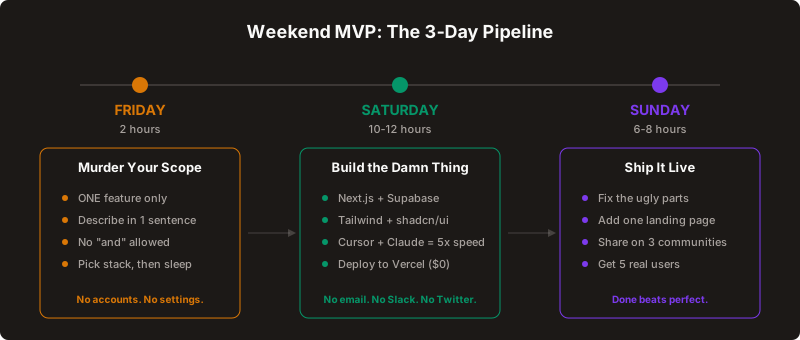
Friday Night: Murder Your Scope
This is the hardest part. Not building — cutting.
Your idea has 15 features. Your MVP has one. Maybe two. The one thing your product does that solves the core problem. Everything else is a lie you're telling yourself about what "minimum" means.
Here's the test: describe your MVP in one sentence without using the word "and." If you can't, you haven't cut enough.
- "Users enter their niche and get an AI-generated competitive analysis." One feature.
- "Freelancers paste a job description and get a custom proposal draft." One feature.
- "Restaurants upload their menu and get SEO-optimized descriptions." One feature.
No user accounts. No settings page. No admin dashboard. No onboarding flow. No dark mode. Definitely no dark mode.
Write down the one feature on a sticky note. Put it on your monitor. Every time you're tempted to add something Saturday, look at the sticky note and ask yourself: "Is this the one feature?" No? Then don't build it.
At Foundry, we've evaluated thousands of startup concepts through our AI debate engine. The pattern is clear: founders who scope tight and ship fast learn 10x more than founders who build "complete" products nobody uses.
Friday night should take 2 hours max. One hour to define the feature. One hour to pick your stack. Then sleep — you'll need it.
Saturday: Build the Damn Thing
Wake up early. Coffee. No email. No Slack. No Twitter. Phone in another room.
The Stack (Non-Negotiable)
Don't waste three hours comparing Next.js vs. Remix vs. SvelteKit. Here's what works:
Frontend + Backend: Next.js. Not because it's the best — because it's the most documented, most AI-understood, and fastest to scaffold. Cursor and Claude can write Next.js in their sleep.
Database: Supabase. Postgres with auth, storage, and an API out of the box. Free tier is plenty for an MVP. Takes 10 minutes to set up.
Styling: Tailwind + shadcn/ui. Pre-built components that look professional. Don't design anything from scratch. Your MVP doesn't need to be beautiful — it needs to exist.
AI layer (if applicable): Claude API or OpenAI API directly. Not a wrapper. You're one fetch() call away from adding AI to anything.
Deployment: Vercel. Push to GitHub, get a live URL. Zero config.
Total cost: $0. Every one of these has a free tier that handles MVP-level traffic.
The Saturday Schedule
9 AM - 12 PM: Scaffold and core logic. npx create-next-app, set up Supabase, build the main page. Use Cursor aggressively — describe what you want in comments and let AI write the first pass. Fix what's wrong, which will be plenty.
12 PM - 1 PM: Lunch. Actually eat. Your code will suck more if you're hungry, and debugging on an empty stomach is how founders develop coffee addictions that cost more than their SaaS.
1 PM - 5 PM: Core feature. This is the only thing that matters. Your one feature, working end to end. Input goes in, value comes out. Ugly is fine. Hardcoded values are fine. Console.log everywhere is fine. It works.
5 PM - 7 PM: Make it not embarrassing. Clean up the worst UI crimes. Add loading states. Handle the obvious error cases. You're not polishing — you're making it usable enough that someone won't close the tab in confusion.
Evening: Break. Seriously. Go for a walk. Watch something. Your brain needs offline processing time, and the bugs you can't fix at 10 PM will solve themselves by 9 AM Sunday. I don't fully understand why this works, but it does.
(Yes, this is a tight schedule. That's the point. Constraints produce results. Unlimited time produces side projects that live in localhost forever.)
Got an idea but not sure it's worth a weekend? Let AI stress-test it first. If it survives, build it Saturday. If it dies, you saved 48 hours.
Try Foundry — freeSunday: Ship It
The scariest day. Because today it stops being "your project" and becomes something real people can judge.
Morning: Landing Page
You need four things on your landing page. Four:
- Headline: What does it do? In 6 words or less.
- Subheadline: Who is it for and why should they care? One sentence.
- The thing: Your actual product, embedded or linked. A screenshot at minimum. A working demo if possible.
- CTA: One button. "Try it free" or "Get started." Not two buttons. Not three options. One.
Build this as your homepage in Next.js. Use a shadcn/ui template. Takes 2 hours max. If you're spending more, you're designing, not shipping.
For copy inspiration, think about what would make someone care in the three seconds before they bounce. That's your landing page doing its job.
Afternoon: Deploy and Announce
Push to GitHub. Vercel auto-deploys. You now have a live URL.
Buy a domain ($10 on Namecheap). Point it at Vercel. SSL is automatic. Feels real now, doesn't it?
Then tell people. Not "launch on Product Hunt" — that's week 3, not day 3. Tell people:
- Post in 2-3 relevant subreddits (not as spam — as "I built this, here's what I learned")
- Tweet/post it with a short story of why you built it
- Send it to 10 friends who might actually use it, not friends who'll say "looks cool" and never open it again
- Drop it in one Slack or Discord community where your target users hang out
That's it. You're live. You have a product on the internet that real humans can use.
"But It's Ugly"
Good.
Craigslist is ugly. It prints money. Google's first version looked like a CS homework project. Dropbox's MVP was a video — not even a product.
Your ugly MVP teaches you more in one week of real usage than six months of perfecting the gradient on your hero section. Users don't churn because your button has 4px border-radius instead of 8px. They churn because your product doesn't solve their problem. And the only way to find out is to ship.
If your MVP took more than a weekend, you built too much. Strip it back. An MVP isn't "version 1 of your product." It's the smallest possible experiment to test whether anyone cares.
We see this constantly in Foundry's startup evaluations: the founders who ship a janky prototype in 3 days get real user feedback. The founders who build for 3 months get... a product nobody asked for with really nice animations.
The Monday After
You shipped. Now what?
Watch what people actually do. Not what they say — what they do. Which button do they click? Where do they drop off? Do they come back?
If three people use your ugly weekend MVP on Monday and one of them says "when are you adding [feature]?" — you've got something. Build that feature Tuesday night.
If nobody uses it? You just saved yourself six months. Move to the next idea. The weekend is gone either way.
The best founders I know have three or four dead weekend MVPs behind them before the one that worked. The cost of each failure: 48 hours and a domain name. The cost of NOT doing this: months of building something nobody wants.
Got an idea but not sure it's worth a weekend? Let AI stress-test it first — takes 5 minutes →
Marcus Graham
Building tools that help founders validate ideas and launch faster.
AI can find your perfect startup niche in 5 minutes
Two AI agents debate your idea and give you an honest, data-backed assessment. Free.
Find My Niche