10K Signups, $400 MRR
A founder DM'd me last month. Excited. "We just hit 10,000 signups!"
I asked one question: "How many are paying?"
Long pause. "Twenty."
Twenty paying users out of ten thousand. That's a 0.2% conversion rate. His MRR was $400. He'd spent $11,000 on ads to acquire those signups. And he was celebrating.
This is what vanity metrics do to your brain. They feel like progress. They look great in pitch decks. And they hide the fact that your product is a leaking bucket with no bottom.
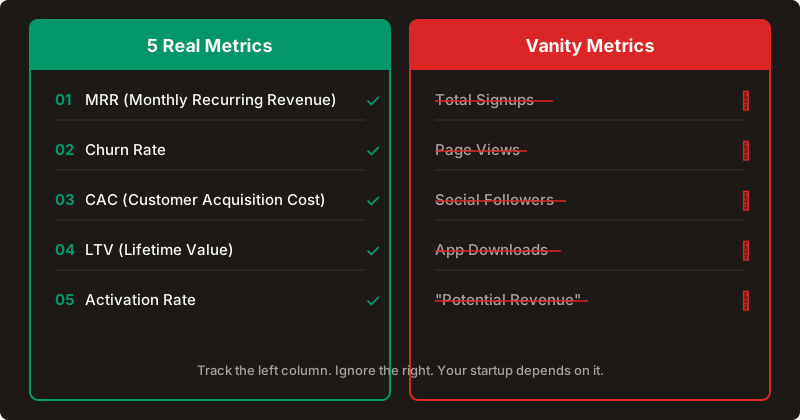
The Vanity Trap
Here's what nobody wants to hear: tracking the wrong numbers is worse than tracking nothing.
With no metrics, you know you're flying blind. You stay paranoid. You ask hard questions. But when you have a dashboard full of green arrows pointing up — total users, page views, social followers, "engagement" — you relax. You think the machine is working.
It isn't. You just built a really nice speedometer for a car that's out of gas.
The pricing decisions you make based on vanity metrics? Garbage in, garbage out. Every single time.
These metrics are noise:
- Total signups — counts tire-kickers and bots equally
- Page views — someone bounced in 3 seconds, congrats
- App downloads — 90% never open the app twice
- Social followers — followers don't pay rent
- "Engagement rate" — the vaguest metric in marketing
- Time on site — could mean they're confused, not interested
- Email list size — a list of 50K with 8% open rate is worse than 2K at 45%
- Feature requests — people request features they'll never use
- NPS score — "would you recommend us?" =/= "would you pay us"
- Total revenue (without context) — $10K/month with $14K in costs is not a business
None of these tell you if your startup will be alive in six months.
The 5 That Keep You Honest
Five metrics. That's it. If these five are healthy, you're probably fine. If any one of them is broken, nothing else matters.
1. MRR (Monthly Recurring Revenue)
Not total revenue. Not GMV. Not "annual contract value divided by maybe." Actual money hitting your account every month from active subscriptions.
Good benchmark: Growing 15%+ month-over-month in the first year. Stripe published data showing the median funded startup grows MRR at about 10-12% monthly. If you're below 5%, something is fundamentally wrong — either your acquisition channels aren't working or your product doesn't solve a real problem.
One caveat: MRR means nothing until you have at least 30-50 paying customers. Below that, statistical noise drowns everything.
2. Churn Rate
The silent killer. Most founders don't even calculate it properly.
Monthly churn = (customers lost this month) / (customers at start of month). Simple math. Brutal implications.
- Below 3% monthly: You're in good shape. That's roughly 30% annual churn — acceptable for SMB SaaS.
- 3-5% monthly: Warning zone. You're losing half your customers every year. Your acquisition treadmill has to run fast.
- Above 5% monthly: Your house is on fire. Stop building features. Stop running ads. Figure out why people leave.
Here's the thing most dashboards hide: churn compounds. At 7% monthly churn, you lose 58% of customers in 12 months. Not in some abstract future — by next March.
3. CAC (Customer Acquisition Cost)
Total sales and marketing spend divided by new customers acquired. Include everything — ads, salaries, tools, content creation, that $200/month SEO tool you forgot about.
Benchmarks depend wildly on your price point. But one rule holds: if you can't recoup CAC within the first 3-4 months of a customer's lifetime, your unit economics are underwater. You're paying $200 to acquire a customer who pays $29/month and churns in month 5. That's $145 in revenue for a $200 investment. You're literally paying people to use your product.
4. LTV (Lifetime Value)
Average revenue per customer multiplied by average customer lifespan. The number that tells you how much a customer is actually worth.
The golden ratio: LTV/CAC should be at least 3:1. Below that, you're buying growth at a loss. Above 5:1, you're probably under-investing in acquisition and leaving money on the table.
But here's where founders screw up — they calculate LTV using the lifespan of their best customers while using the CAC of all customers. Cherry-picking. Your LTV should use median customer lifespan, not the guy who's been subscribed since day one.
5. Activation Rate
The most underrated metric on this list. What percentage of signups actually DO the core action that makes your product valuable?
For Slack, it was sending 2,000 messages as a team. For Dropbox, it was putting one file in a folder. For Foundry, it's completing the AI niche evaluation.
If your activation rate is below 25%, your onboarding is broken. People sign up, look around, get confused or underwhelmed, and leave. You don't have a growth problem. You have a "your front door is locked" problem.
Measure this weekly. It's the earliest signal that something is right or wrong.
Know your metrics before you build. Foundry's AI evaluates your startup idea and maps out the unit economics — free in 5 minutes.
Try Foundry — freeEven Good Metrics Lie (If You Average Them)
I know this contradicts what I just said. Stay with me.
A 4% monthly churn rate looks healthy. But what if your churn for customers acquired through paid ads is 12%, and your churn for organic customers is 1%? The average is fine. The reality is that half your acquisition strategy is burning money.
Same with CAC. Average CAC of $80 means nothing when Google Ads CAC is $180 and referral CAC is $12. You need CAC broken down by channel. Otherwise you'll keep pouring money into the channel that's bleeding you dry because "average CAC looks fine."
We see this pattern constantly in Foundry evaluations. A founder presents solid-looking metrics, but when we segment by channel or cohort, the picture flips completely. Seven out of ten times, the "healthy" numbers hide a dying channel or a toxic cohort that's dragging everything down.
Segment everything. Averages are where truth goes to die.
The Dashboard That Matters
Stop building dashboards to impress investors. Build one that scares you.
Five numbers. Updated weekly. No vanity metrics cluttering the view. When MRR is up and churn is down, celebrate. When activation drops, drop everything else and fix it.
The founders who obsess over these five metrics — and ignore the other fifty — are the ones still running a business a year from now. The ones tracking "total signups" are writing post-mortems.
Which dashboard are you looking at?
Find out if your startup idea has real metrics potential — free AI evaluation →
Marcus Graham
Building tools that help founders validate ideas and launch faster.
AI can find your perfect startup niche in 5 minutes
Two AI agents debate your idea and give you an honest, data-backed assessment. Free.
Find My Niche