$500 Million, Zero Investors
Midjourney made half a billion dollars in revenue last year. They raised exactly zero in venture capital. No seed round. No Series A. No cap table drama. Just a Discord bot, a small team, and millions of people willing to pay $10/month.
Two teenagers built Cal AI — a calorie-tracking app — and hit $40 million in annual revenue. Two kids. No pitch deck. No warm intro to Sequoia. They built something, charged money for it, and the money showed up.
Pieter Levels runs a portfolio of products from his laptop. $3.5 million a year. Solo. No employees. No investors. No board meetings. He ships from Airbnbs and tweets about it.
These aren't outliers anymore. They're the pattern.
The Pitch Deck Is a Résumé for a Job You Don't Want
I'm going to say something that would've been heresy five years ago: for most startups, raising venture capital before revenue is a bad trade.
Not just risky. Bad.
Here's the math nobody puts in their fundraising celebration posts. You raise $2M at a $10M pre-money valuation. You now own 83% of your company. Sounds great. Then you hire 8 people, your burn hits $150K/month, and you have 13 months to figure out product-market fit, build a sales engine, AND grow fast enough to justify a Series A — because if you don't raise again, you're dead.
Eighty percent of seed-funded startups never raise a Series A. That's Crunchbase data, not my opinion.
So what happens? You've got a product that might work, a team that costs $1.8M/year, and investors who need 10x returns. The pressure to grow fast distorts every decision. You add features nobody asked for because they look good in a board deck. You chase enterprise contracts that take 9 months to close because the ARR number impresses investors. You hire a VP of Sales at month 8 because "you need to professionalize" — while you still can't explain why customers churn.
Meanwhile, the founder with $15K MRR and zero funding is sleeping fine. She owns 100%. She can pivot on a Tuesday. Nobody's asking her about Series A timing.
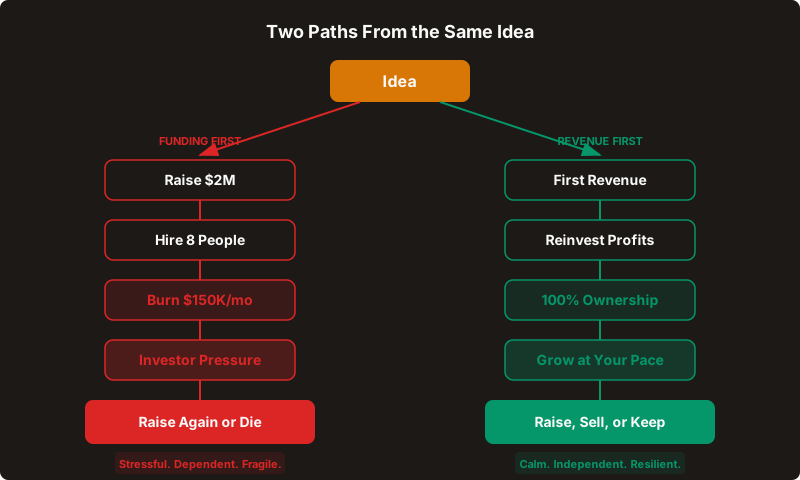
Revenue Is Leverage. Everything Else Is a Story.
There's a reason VCs now actively seek out revenue-generating startups for their first checks. The power dynamic flipped.
When you walk into a fundraise with $30K MRR, you're not asking for permission. You're offering an opportunity. Your terms. Your timeline. Your valuation. The money is a growth accelerant, not life support.
When you walk in with a pitch deck and a prototype? You're auditioning. And the casting director takes 70% of the applicants and sends them home.
I bootstrapped a SaaS to a $2M exit. The single best moment wasn't the exit — it was the first time an investor reached out to ME. Unsolicited. Because the revenue spoke louder than any deck I could've built. Revenue is proof. Everything else is a promise.
The numbers back this up at a macro level too. According to Carta data, median pre-seed valuations dropped 30% from their 2021 peaks. Founders are giving away more equity for less money. But companies with revenue before fundraising can set their own terms because they don't need the money to survive. They want it to accelerate.
Think your idea can generate revenue before funding? Foundry's AI Destroyer will stress-test your monetization path in 5 minutes — free.
Try Foundry — free"But I Need Capital to Build"
Do you? Really?
Cal AI was built by teenagers with zero infrastructure budget. Levels ships products in a weekend using off-the-shelf tools. The solopreneur stack costs $54/month — hosting, database, payments, analytics, everything.
The "I need capital to build" argument made sense in 2008 when servers cost $10K/month and you needed a team of 15 to ship a web app. It doesn't hold in 2026. AI writes code. Cloud is cheap. Distribution is free if you know where your customers hang out.
What you actually need capital for is usually one of three things: hardware-intensive R&D, regulatory compliance in fintech/health, or blitzscaling a marketplace where network effects demand speed. Those are legitimate. Everything else? You can ship a v1 for the cost of a nice dinner.
The founders who tell themselves "I need to raise before I can build" are usually avoiding the harder question: will anyone pay for this? Fundraising feels productive. It has meetings, decks, timelines. But it's displacement activity. Revenue is the actual test.
This Isn't a Prediction. It Already Happened.
We've run thousands of startup ideas through our adversarial debate engine at Foundry — an AI Seeker that builds the case, an AI Destroyer that tears it apart. Here's a pattern we can't ignore:
Ideas with a clear path to revenue in 30 days survive the Destroyer's scrutiny at roughly 3x the rate of ideas that require "scale first, monetize later." It's not even close. When the Destroyer asks "who pays and why?" — the founders who can answer with specifics ("freelance designers, $29/month, replaces 3 hours of manual work") build stronger businesses than the ones who say "we'll figure out monetization after we hit 100K users."
The startup metrics that actually matter almost all orbit revenue: MRR, churn rate, LTV/CAC ratio. Not vanity metrics. Not DAUs. Money.
And this matches what's happening at the macro level. Y Combinator increasingly funds companies that already have revenue. Indie Hackers went from a niche community to a philosophy. The phrase "default alive" — coined by Paul Graham in 2015 — went from contrarian to conventional wisdom. And the biggest AI company by revenue, Midjourney, never needed a single VC dollar.
The "raise first, build later" playbook worked in a zero-interest-rate world where capital was cheaper than time. That world is gone. Money costs something again. And when money costs something, the founders who already have it — from customers — win.
Does this mean VC is dead? No. Venture capital still makes sense for a specific slice of companies: deep tech, network effects, winner-take-all markets. Maybe 10-15% of startups.
For the other 85%? Revenue before fundraising isn't a lifestyle choice. It's the strategy with the highest expected value.
Your first paying customer is a better investor than any VC. They validate your product, fund your development, and never ask for a board seat. Go find them.
See if your idea can make money before needing funding — Foundry's AI stress-tests it free →
Marcus Graham
Building tools that help founders validate ideas and launch faster.
AI can find your perfect startup niche in 5 minutes
Two AI agents debate your idea and give you an honest, data-backed assessment. Free.
Find My Niche