Last month, a founder DM'd me: "I've been building for 8 months. Nobody's signing up. What am I doing wrong?"
I asked one question: "Before you wrote a single line of code, did anyone try to talk you out of this idea?"
Silence.
That's the problem with most validation advice. "Talk to customers!" Sure. Great. Except customer interviews take weeks to schedule, people lie to be polite, and by the time you've done 30 interviews you're already emotionally married to the idea. You'll hear what you want to hear. We all do it.
Here's a spicier take: for early-stage validation, talking to customers is overrated. Not useless — overrated. There's a step most founders skip entirely, and it costs them months.
Kill It With Logic First
Before you talk to a single human, your idea needs to survive an adversarial stress test. Not a friendly brainstorm. Not a "what do you think?" Slack poll. An actual attempt to destroy it.
This is how Foundry's debate engine works: two AI agents argue about your idea. The Seeker builds the strongest possible case FOR it — market size, competitive gaps, monetization paths. The Destroyer tries to demolish every argument. No mercy. No politeness.
We see this pattern constantly: founders come in with what they think is a unique idea that can't fail. The Destroyer finds the fatal flaw in about 90 seconds. Not because the AI is smarter than the founder. Because it has no ego. It doesn't care about your feelings. It asks the questions your co-founder is too nice to ask.
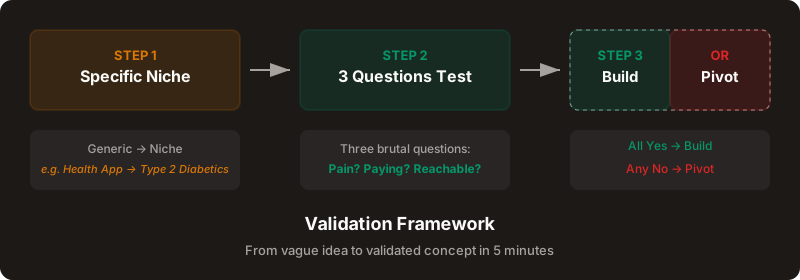
The "Generic to Niche" Transformation
Let me walk you through a real example of what happens during a Foundry evaluation.
The original idea: "An app that helps people eat healthier."
Sounds reasonable, right? Millions of people want to eat healthier. Huge market. Easy pitch.
The Destroyer shreds it in three moves:
-
"Who specifically?" Not "people." Which people? College students? Bodybuilders? Diabetics? New parents? Each group has wildly different needs, budgets, and willingness to pay.
-
"What exists?" MyFitnessPal has 200M+ downloads. Noom raised $540M. You're entering a ring with heavyweights and your pitch is "but mine is different." How?
-
"Why now?" What changed in the world that makes this solvable TODAY in a way it wasn't solvable last year? If nothing changed, you're just late.
Three questions. Maybe two minutes. And the founder now sees the hole.
The transformed idea: "AI meal prep for Type 2 diabetics who hate cooking — weekly plans under $50."
Same domain. Completely different business. Specific audience (Type 2 diabetics). Specific constraint (hate cooking). Specific price anchor ($50/week). The Seeker can now build a real case: addressable market of 37M Americans with Type 2 diabetes, existing spend on meal delivery services averaging $60-80/week, clear pain point that generic apps don't solve.
That transformation took five minutes. Not five months. Not five customer interviews where someone's aunt says "oh that sounds nice, dear."
Got a startup idea? An AI Destroyer will try to kill it while a Seeker defends it. See which side wins — 5 minutes, free.
Try Foundry — freeThe Three Questions That Matter
You don't need Foundry to do this (though it helps — the AI is less forgiving than your brain). You can stress-test any idea with three brutal questions:
Question 1: "Who is already paying to solve this, and how much?"
If the answer is "nobody" — you're creating a new category. That's not validation, that's venture-scale gambling. If the answer is "yes, people pay $X for [inferior solution]" — now you're cooking.
Question 2: "Why would they switch from their current solution to mine?"
"Because mine is better" isn't an answer. 10x better? Or 10% better? Because 10% better doesn't make anyone switch from something that already works. Switching costs are real — habits, integrations, data migration, learning curves. You need a business model that makes switching a no-brainer.
Question 3: "Can I reach 100 of these people in the next 48 hours?"
Not hypothetically. Actually reach them. If you can't find 100 potential customers in two days, your distribution problem will kill you before your product problem does. Doesn't matter how good it is if nobody sees it.
When Customer Interviews DO Matter
I said customer interviews are overrated at the early stage. Not worthless.
After your idea survives the adversarial gauntlet, THEN talk to people. But now you're having a different conversation. Not "would you use this?" (worthless question — everyone says yes). Instead: "Tell me about the last time you dealt with [specific problem]. What did you do? How much did you spend?"
The difference: you're no longer fishing for validation. You're pressure-testing a hypothesis that already survived logical scrutiny. That's research, not therapy.
Rob Fitzpatrick wrote a whole book about this (The Mom Test). His core insight is devastating in its simplicity: if you mention your idea during the interview, you've already failed. You're not there to pitch. You're there to listen.
But you can only listen well when you know exactly what you're listening for. And you only know that after you've tried to kill the idea yourself.
Five Minutes vs. Five Months
Here's what the "build first, validate later" timeline looks like:
Month 1-3: Building. Month 4: "Soft launch" to crickets. Month 5: Panic. Pivot. Rebuild. Month 6-8: Second attempt, slightly less blind. Month 9: Maybe some traction. Maybe not. $20-40K in opportunity cost either way.
Here's the alternative: 5 minutes of adversarial debate. Your idea either survives or it doesn't. If it dies, you saved yourself 8 months. If it survives, you have a specific, defensible version worth building.
I know which timeline I'd pick. But honestly? Most founders still choose the first one. Building feels productive. Thinking feels like stalling. It isn't.
Let Foundry's AI try to destroy your idea — 5 minutes, free →
Marcus Graham
Building tools that help founders validate ideas and launch faster.
AI can find your perfect startup niche in 5 minutes
Two AI agents debate your idea and give you an honest, data-backed assessment. Free.
Find My Niche