I'm Going to Say Something the Bootstrapping Crowd Won't
I bootstrapped a SaaS to $2M exit. And I'm supposed to tell you it was amazing. Freedom. Ownership. Building on my own terms.
Some of that is true. But here's the part that doesn't make it into the Twitter threads:
I went nine months without a single paying customer. I ate ramen not because I was hip — because I was broke. I had a panic attack in a Walmart parking lot at 2 AM because a payment webhook was broken and I had no one to call.
Bootstrapping isn't freedom. It's a trade. You trade investor pressure for something worse — total, crushing responsibility with no safety net.
And I'd still do it again. Let me explain why.
The Ugly Parts Nobody Instagrams
The bootstrapping narrative online is insane. Indie hackers posting "$10K MRR!" screenshots. Pieter Levels tweeting about $3M/year from a laptop in Bali. DHH philosophizing from his racing yacht about how VC is the devil.
What you don't see:
The loneliness is physical. Not metaphorical. When you're a solo founder, there is literally no one who understands your problems. Your friends think you're nuts. Your family asks when you'll get a real job. Your partner watches you stare at a screen until midnight and wonders who they married.
Growth is geologic. The median bootstrapped SaaS takes 14-18 months to reach $1K MRR. Not $10K. One thousand dollars. After a year and a half of work. Meanwhile your former colleagues just got promoted and are making $180K with benefits.
Burnout isn't optional — it's scheduled. You're the developer, the marketer, the support rep, the accountant, the designer, and the CEO. There's no "delegate." There's no "hire someone." There's you, your laptop, and a growing pile of support tickets at 11 PM.
I know founders who quit at month 8 — not because their product failed, but because they couldn't take the silence anymore. No users. No feedback. Just shipping into the void.
So Why Not Just Raise?
Fair question. If bootstrapping is so brutal, why not take $500K from angels and hire a team?
Because the numbers tell a different story than the pitch decks.
Here's what actually happens to most funded startups: You raise $500K. You hire two people. Your burn rate jumps to $40K/month. Now you have 12 months of runway. Twelve months to find product-market fit, build a sales pipeline, AND grow fast enough to raise a Series A — because if you don't raise again, you're dead.
According to Crunchbase data, roughly 80% of seed-funded startups never raise a Series A. They don't all die — some become zombies, limping along with a product nobody wants and investors who won't let them pivot because it doesn't fit the thesis.
You wanted a co-founder? You got a boss. Multiple bosses, actually. With board seats.
And the equity math is brutal. After two rounds of dilution, most founders own 15-25% of their company. So your $10M exit — the one that took 5 years of your life — nets you $1.5M before taxes. That's $300K/year. A senior engineer at Google makes more with zero risk.
(I can already hear the replies: "but MY investors are different." Maybe. Probably not.)
The Math That Changed My Mind
Let me show you two scenarios:
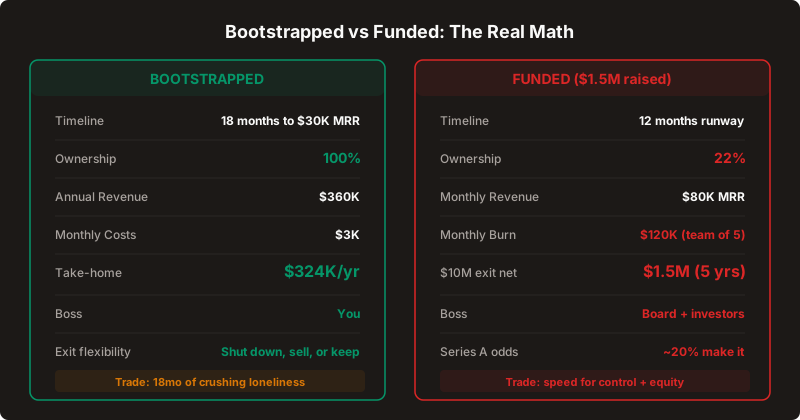
Bootstrapped founder: 18 months of pain, then $30K MRR. You own 100%. Your annual revenue is $360K. Your costs are $3K/month (hosting, tools, one contractor). You take home $324K/year. No board. No reporting. You can work from anywhere, take Fridays off, or shut the whole thing down.
Funded founder: Same product. Raised $1.5M. Hired a team of 5. Revenue at $80K MRR — looks way better, right? But burn is $120K/month. You own 22% after dilution. You need to hit $200K MRR to raise a Series A. You're 6 months from running out of cash and your lead investor just ghosted your last email.
From our data at Foundry — we've analyzed thousands of startup ideas through our adversarial debate engine — the ideas that survive the Destroyer's scrutiny best are almost always niche-focused, capital-efficient plays. The kind that picking the right business model makes or breaks. Turns out, "small and profitable" beats "big and funded" about 9 times out of 10 for first-time founders.
Thinking about bootstrapping? Make sure the idea is worth 18 months of your life. Foundry's AI stress-tests it in 5 minutes — free.
Try Foundry — freeWhat I Wish Someone Had Told Me in Month Three
Bootstrapping works. But it works differently than the indie hacker mythology suggests.
The first year is about survival, not growth. Stop comparing yourself to people who've been at it for 5 years. Your only job for months 1-12 is: don't quit. Ship something. Get one customer. Then two. That's it.
Your pricing is wrong. Every bootstrapper undercharges. You're charging $9/month because you're scared no one will pay $29. They will. The people who won't pay $29 wouldn't have paid $9 either — they were never going to be customers. If you're guessing at prices, stop guessing and use data.
Find three other founders. Not a "community" of 10,000 people. Three. Text them when you're stuck. Celebrate when they ship. This single thing would've saved me six months of spinning.
Revenue solves everything. Not features. Not redesigns. Not "brand awareness." One paying customer fixes more problems than a hundred free signups. Chase the money.
The 18-month wall is real. Almost every bootstrapped founder I know hit a wall around month 14-18 where they seriously considered quitting. The ones who made it through didn't have more talent or better ideas. They had cheaper rent and a partner who believed in them. That's it. Unsexy but true.
The Trade
Here's what I actually believe after living both sides:
Fundraising makes sense for maybe 10% of startups — network-effect businesses, deep-tech plays, markets where winner-takes-all dynamics demand speed. If you're building the next Uber, sure, raise money.
For everyone else? You'll build a better business — and a better life — by staying small, staying patient, and owning what you create. The loneliness is real. The burnout is real. The slow growth will make you question everything.
But at $30K MRR with 100% ownership, nobody can fire you. Nobody can shut down your product. Nobody can tell you to pivot into AI because "that's what the market wants."
That silence that felt so crushing at month three? At month twenty-four, it sounds a lot like freedom.
Not the Instagram kind. The real kind.
See if your idea can survive without funding — Foundry's AI will stress-test it for free →
Marcus Graham
Building tools that help founders validate ideas and launch faster.
AI can find your perfect startup niche in 5 minutes
Two AI agents debate your idea and give you an honest, data-backed assessment. Free.
Find My Niche