Last year a friend called me from a WeWork bathroom. He was crying. Not because his startup was failing — because it was working. He'd raised $2.3M seed, hit $40K MRR, and his lead investor told him it wasn't enough. Grow faster or we're pulling the next tranche.
He'd built a profitable company. Then took money that turned profitability into a death sentence.
I bootstrapped my SaaS to a $2M exit. I'm supposed to be the "anti-VC guy." But I'm not. I've seen bootstrapping destroy people too — eighteen months of loneliness and $400 MRR will hollow you out faster than any investor meeting. I wrote about that part in excruciating detail.
The bootstrapping vs venture capital debate is usually theater. Bootstrappers quote DHH. VC people quote Marc Andreessen. Everyone picks a tribe and argues ideology.
I want to talk about math instead.
The Numbers Nobody Puts Side by Side
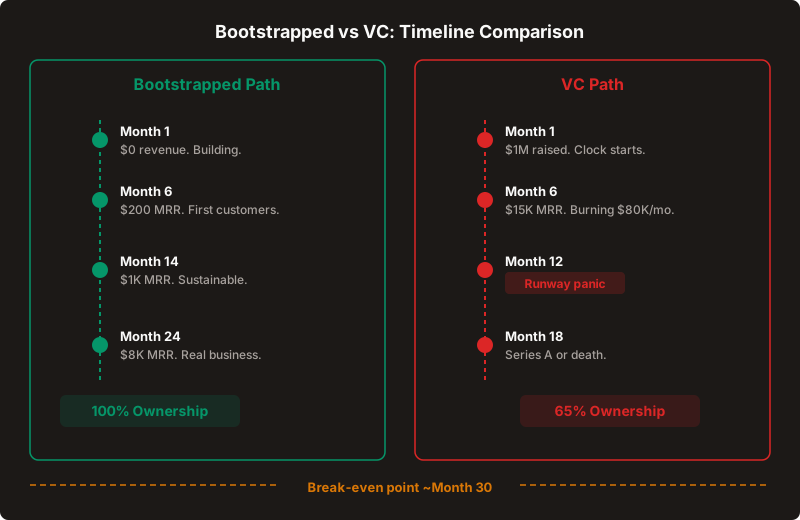
Here's what $1M in VC funding actually buys you:
A team of 3-4 people. Burn rate around $80K/month. Twelve months of runway. You need milestones that justify a Series A — typically $100K+ MRR or explosive growth. Miss those, and you're dead. Not "pivot" dead. Actually dead.
Carta's 2024 data: median time from seed to Series A is 27 months. Your 12 months of runway just got very interesting.
Here's what $0 in funding buys you:
Time. Infinite runway — as long as you can pay rent. No milestones except the ones you set. No board meetings. No quarterly reviews where someone who's never shipped software asks why ARR isn't growing 15% month-over-month.
But also: no team. No buffer. No margin for error. You're one bad month from working at Starbucks, and the median bootstrapped SaaS takes 14-18 months to hit $1K MRR.
Neither option is good. That's the part nobody says out loud.
When VC Actually Makes Sense
I'll say something my bootstrapper friends hate: sometimes raising money is the correct move.
Three conditions. All three must be true. Not one, not two — all three.
Your market has winner-take-all dynamics. Network effects, data moats, regulatory capture — if the first to scale wins, speed trumps efficiency. Uber couldn't have been bootstrapped. The market structure demanded capital.
You've already validated demand. Not "people said they'd pay." Actual revenue. Actual retention. Taking money to figure out if people want your product is the most expensive market research on earth. Validate first — it takes days, not months.
You personally want to build a large company. Most founders I know actually want a $3M/year lifestyle business. They raise VC because they think it's what you're supposed to do. Then spend five years optimizing metrics that make investors happy and them miserable.
All three true? Raise aggressively. Even one false? Expensive lottery ticket.
Before deciding how to fund it — make sure the idea itself holds up. Foundry's AI stress-tests startup ideas against real market data. Takes 5 minutes, costs nothing.
Try Foundry — freeThe Hidden Tax on Both Sides
Every bootstrapper pays a tax nobody talks about: opportunity cost. Those 18 months of $0 MRR? That's $180K-$300K in salary you didn't earn. Your savings account doesn't know you're "building equity." Your landlord doesn't accept MRR projections.
The funded founder pays a different tax: control. And it compounds worse than any credit card debt.
Board seats come with preferences. Liquidation preferences mean your investors get paid before you — often 1x-2x their investment. So your $5M exit? After $2M in preferred returns, you split $3M with a cap table that says you own 25%. That's $750K for three years of work. Before taxes.
Sahil Lavingia told the whole internet that Gumroad raised $8M, grew to $5M ARR, and still couldn't afford to hire. The money came with strings that made profitability structurally impossible. He bought it back and restructured. Everyone calls it a "bootstrapping win." It's actually a cautionary tale about what VC does to companies that don't fit the VC model.
Most companies don't fit the VC model.
The Decision Framework I Wish I'd Had
Forget ideology. Run these four checks:
Check 1: What's your burn-to-revenue gap? If you can get to $5K MRR in 6 months with zero investment — from savings, a part-time job, consulting on the side — bootstrap. The math works. Painfully, but it works.
Check 2: What does your competitive window look like? If three other teams are building the same thing and the market rewards speed, waiting 18 months for organic growth means arriving after the party ended. Raise money. Move fast.
Check 3: What are you actually optimizing for? $30K MRR at 100% ownership = $360K/year in your pocket. $300K MRR at 22% ownership with $150K/month burn = $396K/year in revenue you don't get to keep, with a board that can fire you. These are different things. The metrics that actually matter depend entirely on which game you're playing.
Check 4: Could you walk away? If your investor says "double headcount or we pull funding" — can you say no? The option that lets you survive a bad outcome is usually the right one.
In Foundry's debate engine, the pattern across thousands of stress-tested ideas is clear: ~85% of first-time founders are building products better served by bootstrapping. Not because VC is evil — because their markets don't align with the VC model. The 15% who should raise usually already know it.
Stop Asking the Wrong Question
"Bootstrapping vs VC" frames this as identity. Like picking a religion. You're not.
You're picking a financing strategy for a specific company at a specific stage. Some founders bootstrap to $10K MRR then raise a seed because the unit economics proved out. That's not selling out — that's being smart. Others raise a seed, realize their market is a niche, and buy back equity to run a calm company. That's not giving up — that's pattern recognition.
The worst move is picking a camp and ignoring data. I've watched bootstrappers slowly die refusing to raise when their market demanded speed. I've watched funded founders burn $3M on features nobody wanted because admitting the idea was small felt like failure.
Your job isn't to be a "bootstrapper" or a "funded founder." It's to build something people pay for. Get your first customers. Prove revenue. Then decide how to pour fuel on it.
Not sure if your idea needs funding or just guts? Let Foundry's AI run the numbers →
Marcus Graham
Building tools that help founders validate ideas and launch faster.
AI can find your perfect startup niche in 5 minutes
Two AI agents debate your idea and give you an honest, data-backed assessment. Free.
Find My Niche