I Burned $23,000 Before Making a Dollar
My first startup. 2019. I rented a WeWork desk ($400/month), bought a $2,000 MacBook Pro "for development," paid a designer $5,000 for a logo and brand kit, dropped $3,000 on a custom landing page, hired a part-time developer for $4,000/month, and spent $800 on incorporation + legal.
Seven months later I had a beautiful brand, zero customers, and an empty bank account.
The product that eventually sold for $2M? I built the MVP on a $300 Chromebook using free tools. Total cost for the first six months: under $200.
The startup cost myth is the most expensive lie in tech. Real startup costs in 2026? Let me dismantle it.
Real Startup Costs: The Numbers
Here's what it actually costs to go from idea to live product with paying customers in 2026. Not theoretical. Not "it depends." Real line items, real prices.
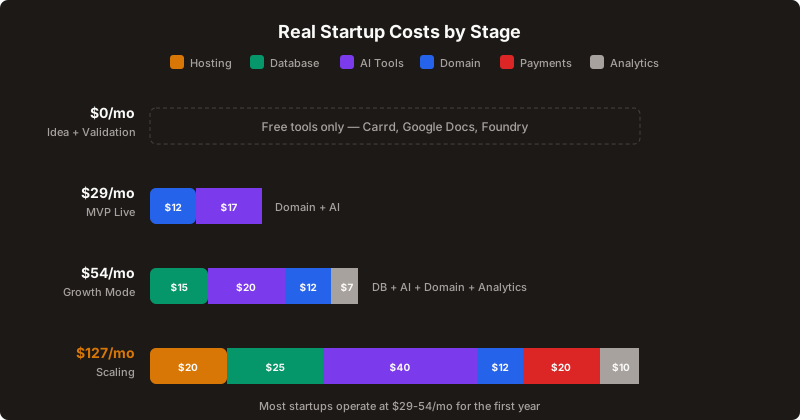
Tier 0 — Validation: $0/month
You don't spend a cent until you've confirmed people want what you're building. Talk to potential customers. Run a fake door test. Build a waitlist with a free Carrd page. Use Foundry's niche finder — it's free — to evaluate your market before you write a line of code.
$0. Seriously.
Tier 1 — MVP Live: $10-29/month
- Hosting (Vercel): $0
- Database (Supabase free tier): $0
- Domain: $10-15/year (~$1/month)
- AI for building (Claude API): $5-20/month
- Payments (Stripe): 2.9% + 30¢ per transaction — you only pay when you earn
- Email (Resend free tier): $0
That's it. A live product on the internet, accepting payments, for less than a Netflix subscription. I wrote about the exact tools in the $54/month solopreneur stack — the difference is that stack includes growth-stage tools you don't need yet.
Tier 2 — Growth Mode: $54-127/month
Once you have paying customers (not before), you add:
- Supabase Pro: $25/month
- Vercel Pro: $20/month
- Analytics (Plausible): $9/month
- Error tracking (Sentry free tier): $0
- Transactional email (Resend Pro): $20/month
Notice the pattern. You scale spending with revenue. Not before revenue. The moment you're spending money before customers are paying you, you're playing pretend.
Where the $50K Myth Comes From
Three places:
Accelerators and VCs. They need you to think launching is expensive because that's how they justify taking 7% of your company for $125K. If you knew the actual startup costs in 2026, you'd never walk into a demo day.
Enterprise tooling sold to indie hackers. You don't need Datadog. You don't need Segment. You don't need a $500/month Intercom plan for your 12 users. These tools exist for companies with 50 employees, not founders with 50 customers.
Founders who confuse spending with progress. Buying a premium Figma plan feels like building. Setting up a complex CI/CD pipeline feels like shipping. Registering an LLC in Delaware feels like launching. None of it is. The only thing that matters is: can someone give you money for what you've built?
Pieter Levels built Nomad List on a PHP file and a JSON database. Sahil Lavingia launched Gumroad's first version in a weekend. Ben Tossell started Makerpad with a no-code website and a Stripe link.
None of them needed $50K.
Foundry's AI business plan costs about 50 credits — roughly $2. That's your market analysis, competitor breakdown, and revenue model in one shot. No consultants. No $5K "strategy workshops."
Try Foundry — freeThe Costs That Actually Kill You
The dangerous expenses aren't tools. They're time sinks disguised as productivity.
Premature hiring. You hire a contractor at $60/hour to build something Claude can build in 20 minutes. I've seen founders spend $8,000 on features an AI coding assistant handles in an afternoon. Before you hire anyone, try building your MVP in a weekend with AI. If that doesn't work, then consider hiring.
Over-engineering. Kubernetes for your 30-user app. Microservices when a monolith would ship in a week. Multi-region deployment when all your customers are in Ohio. Every hour spent on infrastructure you don't need is an hour not spent talking to customers.
Premature scaling of paid tools. You upgrade to the $79/month plan because the free tier "might" run out. It won't. Not at your stage. Start free, upgrade when you hit limits, not when you imagine limits.
Legal paranoia. You don't need an LLC to validate. You don't need a trademark to launch. You don't need a privacy lawyer to put up a landing page. Do the legal stuff after you have revenue. Not before.
The real startup costs 2026 aren't in the tools — they're in your decisions about time.
A Month-by-Month Reality Check
Month 1: $0. Validate. Talk to people. Use free tools. Don't build yet.
Month 2: $15-25. Domain + Claude API. Build and ship your MVP.
Month 3: $15-25. Same costs. You're iterating based on feedback, getting your first customers without spending on ads.
Month 4-6: $54-80. You have paying customers. Upgrade database. Add analytics. Your revenue should cover these costs — if it doesn't, your problem isn't the budget.
Month 7-12: $100-200. You're growing. Maybe add a proper email service, better hosting, a few paid tools. But by now you're making money, and these are business expenses, not personal sacrifices.
Total first-year cost: $500-$1,500.
Not $50,000. Not $20,000. Under two thousand dollars, all-in, from idea to running business.
Your time is the real currency. Not dollars. And in 2026, AI has made the time cost collapse too. What took a solo founder six months in 2020 takes six weeks now. What took six weeks takes a weekend.
The barrier to launching a startup has never been lower. The tools are free. The infrastructure is free. The knowledge is free. The AI assistants cost less than your coffee habit.
The only thing standing between you and a launched product is the decision to stop researching and start building.
So stop reading blog posts about startup costs.
Marcus Graham
Building tools that help founders validate ideas and launch faster.
AI can find your perfect startup niche in 5 minutes
Two AI agents debate your idea and give you an honest, data-backed assessment. Free.
Find My Niche