Stop reading comparison articles. I'm serious.
Every "SaaS vs Marketplace vs Content" post you've seen follows the same script: three neat columns, pros and cons, "it depends on your situation." You close the tab knowing exactly as much as when you opened it. Which is nothing.
So here's an actual position: if you're a solo founder, you should almost certainly build a SaaS. Not because I'm a SaaS fanboy. Because I've watched the other models kill founders who didn't understand what they were signing up for.
We see this play out constantly in Foundry's evaluations. A founder comes in with a marketplace idea. The Seeker AI builds a beautiful case — massive TAM, network effects, winner-take-all dynamics. Then the Destroyer asks one question: "How will you get supply AND demand simultaneously, alone, with no budget?" And the whole thing collapses.
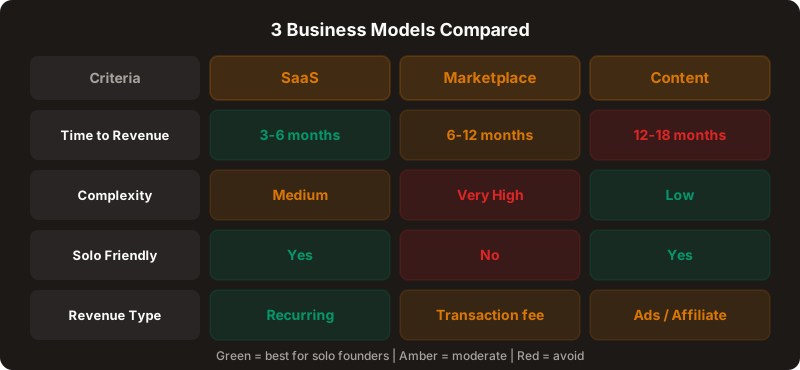
The Marketplace Trap
Marketplaces are seductive. Uber. Airbnb. Etsy. Billion-dollar platforms that "just connect buyers and sellers." How hard can it be?
Astronomically hard.
Every marketplace has a chicken-and-egg problem. Sellers won't join without buyers. Buyers won't join without sellers. Uber solved this by burning $25 billion in VC money to subsidize both sides simultaneously. You have a credit card and weekends.
I talked to a founder last year who spent 14 months building a marketplace for freelance video editors. Beautiful product. Zero liquidity. He had 200 editors and 11 clients. The editors churned because there was no work. The clients churned because the talent pool felt empty. A death spiral that no feature can fix.
The marketplace model has another hidden cost nobody mentions: you need two marketing strategies. One to acquire supply. One to acquire demand. Each with its own channels, messaging, and conversion funnels. For a solo founder, that's not ambitious — it's suicidal.
Content Businesses: The Long, Slow Grind
Content is the other popular choice. "I'll start a newsletter/blog/YouTube channel, build an audience, then monetize." Sounds organic. Sounds cheap.
It is cheap. It's also brutally slow.
Here's the math nobody does upfront: a content business typically needs 12-18 months of consistent publishing before generating meaningful revenue. Not side-project revenue — rent-paying revenue. During those 18 months you're producing content for free, hoping the compound effect kicks in, while your savings account bleeds out.
The Wirecutter took 3 years before the NYT acquired it for reportedly $30M. Morning Brew took 2.5 years to hit $1M ARR. These are SUCCESS stories. For every Wirecutter there are 10,000 abandoned Substacks with 47 subscribers.
Can it work? Absolutely. Is it the right model for someone who needs revenue in the next 6 months? Almost never.
Not sure which business model fits your idea? Foundry's AI debate engine stress-tests your plan — including the monetization strategy. Free.
Try Foundry — freeWhy SaaS Wins (and It's Not Recurring Revenue)
Everyone says SaaS wins because of recurring revenue. That's true but boring. The real reason is more fundamental.
SaaS gives you the fastest feedback loop.
Build a thing. Charge for it. Either people pay or they don't. You know within weeks — not months, not years — whether you're onto something. Compare that to a marketplace (months to reach liquidity) or content (months to build audience). The speed of learning is the real advantage.
Pieter Levels built Nomad List as a solo founder. $2M+ ARR. No marketplace dynamics. No content monetization puzzle. Just a product, a price, and people who pay because it solves their problem.
Basecamp. Carrd. Plausible Analytics. ConvertKit in its early days. All started as solo or tiny-team SaaS products. All reached profitability without solving the chicken-and-egg problem. Without building an audience for 18 months first.
The SaaS playbook for solo founders:
- Pick a specific audience with a specific pain — not "businesses" but "freelance accountants who hate invoicing"
- Build the smallest thing that solves it — a weekend MVP, not a 6-month opus
- Charge from day one — even $9/month proves willingness to pay
- Grow one channel at a time — SEO, or cold outreach, or community. Not all three
That's it. No two-sided market. No 18-month content ramp. Just you, a problem, and a credit card form.
The Exception (Because There's Always One)
I'd be dishonest if I said SaaS is always right. It's not.
If you have an existing audience — 10K+ email subscribers, a popular blog, a YouTube channel — content monetization makes sense. You've already paid the 18-month tax. Capitalize on it.
If you have deep connections on BOTH sides of a market — you were a recruiter for 10 years and know 500 hiring managers AND 2,000 candidates personally — a marketplace might work. You can bootstrap liquidity through relationships, not money.
But notice the pattern: these exceptions require assets you already have. Not assets you plan to build.
For everyone else? Validate a SaaS idea and start building.
Choosing Isn't the Hard Part
Here's what nobody tells you: picking the model is a 10-minute decision. Executing it is a 10-year journey. Founders agonize over SaaS vs marketplace vs content for weeks, using the decision itself as a procrastination tool.
Yes, I just called you out. And yes, I've done it too.
The business model matters less than your ability to ship something, put it in front of real people, and listen to what happens. SaaS makes that loop fastest. That's the whole argument.
Stop comparing models. Pick SaaS. Ship something this week. If it doesn't work, you'll know in 30 days — not 30 months.
Find the right SaaS idea for your skills — Foundry's AI debate takes 5 minutes →
Marcus Graham
Building tools that help founders validate ideas and launch faster.
AI can find your perfect startup niche in 5 minutes
Two AI agents debate your idea and give you an honest, data-backed assessment. Free.
Find My Niche