"Talk to Customers" Is Destroying Your Startup
Everyone says it. YC says it. Paul Graham says it. Every startup book, podcast, and Twitter thread: talk to your customers.
And they're right. Sort of.
Because what happens is this: you schedule 40 calls. You describe your brilliant idea. You watch people nod enthusiastically. You write down "strong interest" in your spreadsheet. You go build for 6 months. You launch.
Four people sign up. Four. Out of 40 enthusiastic yeses.
I did exactly this with my first product. Those 40 calls cost me roughly 80 hours and $0 in revenue. The polite nods were worth less than nothing — they were actively harmful, because they made me confident in something nobody actually wanted.
Customer interviews work. The way most founders do them doesn't.
The 40-to-4 Problem
Here's why the conversion from "I'd totally use that!" to actually pulling out a credit card is roughly 10:1. And I'm being generous.
People are polite. Your mom would never tell you your idea is bad. Neither will most strangers, especially when you're sitting across from them radiating enthusiasm. Humans are conflict-avoidant machines. Saying "yeah, sounds cool" costs them nothing. Saying "I don't think I'd pay for that" feels rude. So they don't say it.
You're pitching, not listening. Most founders walk into an interview with a deck. Or a prototype. Or at minimum a rehearsed description that ends with "...so would you use this?" The moment you describe your solution, the interview is over. You've turned a research conversation into a sales pitch. And people are terrible at predicting what they'll buy — even to themselves.
Hypothetical money is fake money. "Would you pay $20/month?" means nothing. Zero. It's a hypothetical about a future state that doesn't exist yet. The only signal that matters is: has this person already spent money solving this problem? If the answer is no, you're building a vitamin, not a painkiller.
Rob Fitzpatrick wrote an entire book about this — The Mom Test. The title says everything: if even your mom could give you a false positive, your question is broken.
Why This Isn't Just Bad Luck
We see this pattern constantly at Foundry. When founders run ideas through our adversarial AI debate engine, the Destroyer loves picking apart "validated" ideas. And the most common vulnerability? "Validation was based on interviews where the founder described the product."
That's not validation. That's confirmation bias with a spreadsheet.
Real validation looks different. It's ugly. It doesn't feel good. The answers are ambiguous and frustrating. That's how you know you're doing it right.
If you're still at the early stage of figuring out whether your idea has legs, the quality of your questions determines everything.
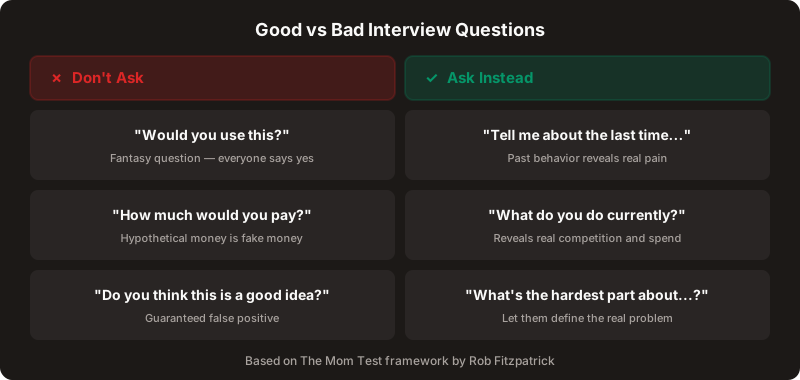
5 Questions That Actually Extract Truth
These aren't theoretical. They come from The Mom Test framework, combined with what we've seen work for founders using Foundry.
1. "Tell me about the last time you dealt with [problem]."
Not "do you have this problem?" — that's a yes/no trap. You want a story. Specific. When. Where. What happened. If they can't recall a specific instance, the problem isn't painful enough. Walk away.
2. "What do you currently do to solve it?"
This reveals two things: whether they care enough to have found ANY solution (even a terrible one), and what your actual competition is. Spoiler: your competition isn't other software. It's spreadsheets, Post-it notes, email threads, and "I just deal with it."
3. "How much does that cost you — in money or time?"
Now you're talking real numbers. Not hypothetical willingness to pay. Real current spend. If someone pays $200/month for a clunky tool that half-solves their problem, there's a market. If the answer is "$0 and 5 minutes a week" — that's your signal to pivot.
4. "What's the hardest part about [their current workflow]?"
Let THEM tell you what sucks. Don't suggest pain points. Don't lead. If they say "honestly, it works fine," believe them. That's the most valuable sentence in customer discovery: "it works fine." It means go find a different problem.
5. "Who else should I talk to about this?"
Two purposes. First: more leads. Second, and this is subtle — if they're excited enough to refer you to someone, the problem is real. If they shrug and say "I dunno, maybe check Reddit?" — that's lukewarm, and lukewarm kills startups.
Before you schedule 40 interviews, let AI try to destroy your idea first. It's less polite than your interview subjects — and more useful.
Try Foundry — free5 Questions That Will Poison Your Data
Stop asking these. Today.
1. "Would you use a product that does X?"
This is a fantasy question. People are terrible at predicting future behavior. Study after study confirms it. The question you're actually asking is "can you imagine a scenario where you'd use this?" Yes, they can. Imagination is cheap.
2. "How much would you pay for X?"
They'll anchor to whatever sounds reasonable and non-committal. $10? $20? Sure, whatever. These numbers mean absolutely nothing. Instead, ask what they currently pay for existing solutions. That's the real price ceiling.
3. "Do you think X is a good idea?"
Everyone thinks every idea is a good idea. Especially in person. Especially when you look hopeful. This question is a guaranteed false positive.
4. "What features would you want?"
Congratulations, you've just started a design-by-committee session. Customers are great at describing problems. They're terrible at designing solutions. Henry Ford's (possibly apocryphal) horse quote exists for a reason.
5. "Would you recommend this to a friend?"
The NPS question. Useless in pre-product interviews. They haven't used anything. They're recommending a concept. I would recommend free pizza to a friend. Doesn't mean I'd pay $20/month for a pizza subscription app.
(Yes, this sounds obvious. But go look at your last batch of interview notes. How many of these questions did you ask? Be honest.)
The Mom Test in Practice
Here's the cheat sheet. Three rules:
Talk about their life, not your idea. The moment you describe your product, you've contaminated the data. Keep your mouth shut about what you're building. Ask about their world. Their problems. Their day. Their frustrations.
Ask about specifics in the past, not generics about the future. "Last time" beats "would you ever." Past behavior is the only reliable predictor of future behavior. Everything else is theater.
Follow the money. Every question should eventually lead back to: who pays, how much, how often. If nobody pays for any solution to this problem right now, you're creating a new market. That's 100x harder than serving an existing one.
Rob Fitzpatrick says something I think about constantly: a good customer interview is one where you don't mention your product at all. The customer talks about their life, their problems, and their current solutions. You listen. You take notes. You leave.
It feels wrong. It feels like you're not "selling." That's the point.
What About the Ideas That Don't Survive Interviews?
Kill them. Fast.
The worst thing you can do is hear lukewarm responses and keep going because "maybe I just need to talk to more people." No. If 10 people who match your ICP can't describe the problem without prompting, it's not a problem.
Our Destroyer AI is merciless about this. When it evaluates an idea through Foundry's debate engine, one of the first things it checks is: are people currently spending money to solve this? If not, the idea gets a low score. Not because it's bad — because most startups fail by building solutions for problems that aren't painful enough to pay for.
Kill the weak ideas. The good ones survive.
Run your idea through Foundry's Destroyer — it's less polite than your interview subjects →
Marcus Graham
Building tools that help founders validate ideas and launch faster.
AI can find your perfect startup niche in 5 minutes
Two AI agents debate your idea and give you an honest, data-backed assessment. Free.
Find My Niche