I'm going to tell you something most startup advisors won't admit: the idea almost never matters.
I know. Heresy. Every accelerator pitch starts with "tell us about your idea." Every VC deck opens with the problem slide. The entire startup mythology is built around the eureka moment — the shower thought that becomes a billion-dollar company.
It's mostly fiction.
We've run thousands of startup ideas through Foundry's adversarial AI debate engine — where one AI argues FOR the idea and another tries to destroy it. After watching that many ideas get stress-tested, a pattern emerges that nobody talks about at demo day: the ideas that fail and the ideas that succeed often look identical on paper. The difference is everything around the idea.
The Real Killer Isn't What You Think
CB Insights published their famous autopsy of 101 failed startups. "No market need" topped the list at 42%. Most people read that as "bad idea." That's wrong.
"No market need" means you built something nobody asked for. Not that nobody COULD want it. You aimed at the wrong people, or you aimed at the right people and built the wrong version.
Slack started as a video game company's internal tool. Instagram started as a bourbon-sharing app called Burbn. The ideas were terrible. The pivots worked because the founders eventually found the right audience.
You don't have a Slack-sized runway to stumble into product-market fit.
Three Patterns We See Over and Over
After analyzing ideas through our debate engine, three failure modes show up in roughly 7 out of 10 evaluations. Not occasionally. Constantly.
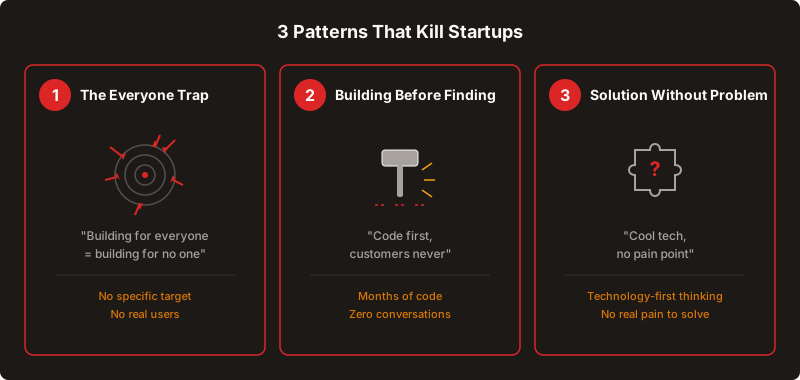
Pattern 1: The "Everyone" Trap.
"My target market is anyone who..." — stop. Right there. That sentence is a death sentence. When your AI Destroyer challenges "who specifically would pay $29/month for this?", founders freeze. They haven't thought past "people who need productivity tools." That's not a market. That's a wish.
Basecamp makes project management software. So does Monday, Asana, Notion, ClickUp, and about 400 others. Basecamp charges $349/month flat — no per-seat pricing — and they're profitable. Their secret? They picked a ruthlessly specific customer: small teams who hate complexity. Not "anyone who manages projects."
Pattern 2: Building the product before finding the customer.
This one is personal. I spent four months coding a beautiful SaaS before talking to a single potential user. Launched to silence. The product was fine. The audience was imaginary.
Most technical founders do this. Code is comfortable. Customer conversations are terrifying. So we hide behind "just one more feature" until the runway disappears.
When Foundry's Seeker AI proposes an idea and the Destroyer challenges it, the first question isn't "is the technology feasible?" It's "who is already paying money to solve this problem, and how much?" If nobody's paying — not theoretically, not "they would if" — actually paying right now? That's your signal.
Pattern 3: The solution looking for a problem.
"We use AI to..." — I hear this opener dozens of times. The technology comes first. The problem comes second. Sometimes the problem never comes at all.
Here's a test: can you describe what your startup does without mentioning the technology? "We help freelance designers find clients in 48 hours." That's a problem. "We use machine learning to optimize the design marketplace experience." That's a press release nobody will read.
Think your startup idea is the exception? Two AI agents will argue for and against it — no mercy, no politeness. 5 minutes, free.
Try Foundry — freeThe Uncomfortable Truth About "Pivot"
Everyone loves pivot stories. "We pivoted and found product-market fit!" Great narrative. Terrible survival strategy.
Pivoting means you burned months (or years) of cash building the wrong thing. For a bootstrapped solo founder? You probably can't afford that lesson.
(I can already hear the replies: "but my case is different." It isn't.)
The founders who consistently win aren't better at pivoting. They're better at validating before they build. They kill bad ideas in minutes, not months. They treat the idea-to-validation step as the highest-leverage hour of their entire startup journey — because it is.
What Actually Matters More Than the Idea
If the idea isn't the thing, what is?
Audience specificity. Not "who could use this" but "who will pay for this on day one, and where do they hang out online?"
Existing spend. Are people already paying for a worse solution? If yes, you have a market. If no, you're creating demand — which is 10x harder and 10x more expensive.
Business model fit. A brilliant idea with the wrong monetization model dies just as dead as a bad idea. Solo founders who pick marketplace models over SaaS are playing the game on hard mode, and most don't realize it until month six.
Look, you can spend the next year learning this through painful experience. Or you can spend 5 minutes stress-testing your idea with an AI that's specifically designed to find the holes in your plan. One of those options costs you time and money. The other costs you nothing.
Marcus Graham
Building tools that help founders validate ideas and launch faster.
AI can find your perfect startup niche in 5 minutes
Two AI agents debate your idea and give you an honest, data-backed assessment. Free.
Find My Niche